How to Clean Artificial Turf: Routine and Pet Messes
How to clean artificial turf with a simple schedule, step-by-step rinsing and brushing, pet waste and odor fixes, and the chemicals to avoid.
It's the second day after a hard rain and the dog yard still has a shallow puddle sitting in the low corner. The path from the patio door to the fence is flattened into a shiny ribbon, last week's leaves are matted down into the fibers, and the whole surface gives off a faint ammonia smell the moment the sun comes out. Nothing is broken. Nothing is even especially dirty. The turf is doing exactly what turf does when nobody removes the debris, rinses the urine out of the infill or lifts the pile back up.
Learning how to clean artificial turf is mostly a drainage and fiber job. Chemicals come last, and often they don't come at all. Clear the debris, rinse deep enough to reach the base, brush the pile upright so air and water can move through it, and most of the problems people pay someone to solve never start. Skip those steps and no bottle in the aisle will rescue the surface.
The order matters, and so does knowing when a rinse is the wrong answer.
Step-by-Step Cleaning and Brushing Technique
Start by walking the surface, not by reaching for the hose. A school-facilities quick-reference guide on synthetic turf maintenance calls for a daily inspection for torn seams, damaged inlays, foreign objects and liquids on fields in active use, plus a sweeper pass, ideally with a magnet, to pull metal out of the pile. At backyard scale the same check is a short walk after a storm or a party, and it is the difference between a five-minute edge repair and a full re-stretch. The same guide notes that some manufacturers require basic grooming, brushing and inspection every 100 hours of play to keep warranty coverage, which is a usage meter rather than a calendar date.
Use this sequence if you are cleaning artificial turf for the first time, and work the steps in order. Each one sets up the next.
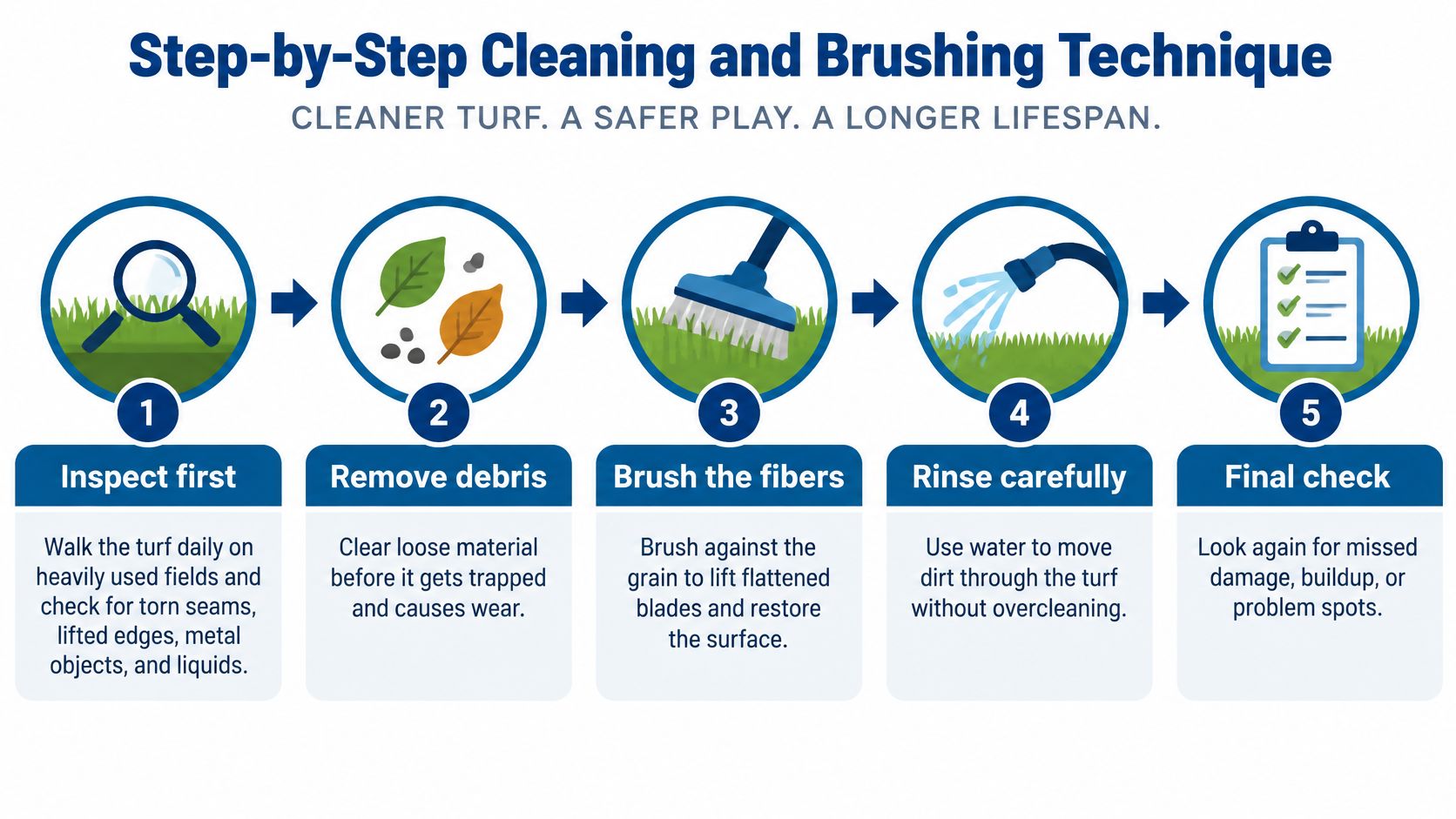
- Inspect first. Walk the fence line, the patio edge and every seam. Look for lifted edges, split seams, damaged inlays, foreign objects and anything wet that should not be. Press the pile with your palm; a hard spot means compacted infill the brush has been skipping.
- Move debris to the edges. Sweep or blow leaves, twigs, seed heads and clippings onto the border, never into a drain. A blower on low clears dry debris in minutes. Damp leaves need a stiff broom, because a blower just rolls them around.
- Lift solids without smearing. Scoop pet waste into a bag and take it off the surface. Fresh waste smears into the fibers and stains them, so give it a few minutes to firm up before you lift it.
- Rinse until the water gets through. Set a hose at moderate pressure and soak the spot until water moves down into the base, then let it drain. A quick pass over the top barely touches urine, which sits in the infill where the smell lives. Rinsing is about volume, not wetting the blades. If water stands on the surface instead of draining, the problem is compacted infill or the base beneath it, and another rinse will not move either one.
- Treat only what needs treating. Odor that survives a proper rinse gets a manufacturer-approved enzymatic cleaner at the label's dilution, left for its stated contact time, then rinsed out. Most of the surface never needs this step.
- Brush the pile upright. This is the step people skip, and it decides how the surface looks and drains through the season.
Brush to lift, not to scrub. Penn State's synthetic turf best-management guidance recommends brushing roughly every three to four weeks during the playing season, with the brush set to "tickle" the surface rather than bearing the machine's full weight. Save deeper brushing for localized areas where infill has shifted, and limit vertical star-shaped slicer units to two or three uses a year, because excessive penetration disturbs the infill profile. Work in overlapping passes against the prevailing lay of the fibers.
Where brushing goes wrong
Three habits wreck a surface faster than dirt does. Dragging an unapproved heavy brush tears at the backing. Scraping the backing itself, usually while chasing a stain, opens the one layer you cannot repair in place. And overworking a single worn path, the strip from the door to the gate, thins the pile there while the rest of the yard stays flat.
On a dog run, brush the path and not the lawn. A few passes over the strip your dog actually uses beats an hour over the whole yard.
Log the date when you finish, then check seams, edge restraints, low spots, odor sources and infill depth while you are still outside. A surface that is right feels springy underfoot, sheds water instead of holding it, and smells of nothing once it dries. Because brush settings, infill type and backing construction vary by product, the manufacturer's instructions win any argument with general advice.
Cleaning Schedule by Task and Frequency
Most turf problems are timing problems, not technique problems. A surface cleaned beautifully twice a year still fails if leaves sit on it for a month and urine goes unrinsed for a week. For everyday grime, the routine is mechanical removal plus water: Ohio's environmental guidance on synthetic turf calls for sweeping, blowing or vacuuming leaves, litter and other debris because buildup interferes with the surface's stormwater and drainage function, and confirms that turf can be rinsed with water.
Build the calendar around four triggers instead of a fixed date: pet use, weather, foot traffic and the season.
| Task | Frequency | Trigger or check |
|---|---|---|
| Remove solid pet waste | Daily | Before it dries and spreads |
| Sweep or blow leaves and debris | Weekly | More often under trees |
| Rinse urine areas | After each pet visit | Rinse until the spot is wet through |
| Check drainage | After every heavy rain | Standing water that lasts hours |
| Inspect seams, edges and low spots | Monthly | After storms or heavy use |
| Brush high-traffic paths | Every 3-4 weeks in season | Fibers matted or flattened |
| Deep grooming and infill check | Annually | Compaction, thinning infill or persistent odor |
A household with one dog on a fenced backyard runs the monthly column and rarely needs more. A daycare with a dozen dogs on the same patch runs the daily column and treats the inspection as a hard deadline rather than a suggestion. Filing the work by task instead of by date also keeps it cheap. Debris removal protects drainage, brushing redistributes fiber and infill, and periodic decompaction prevents the hard spots that show up later as shallow puddles.
If the infill at your busiest doorway has gone thin or shifted, read up on artificial turf infill before you top it up, because the wrong grade migrates straight back out. Sort every job the same way: remove it mechanically, rinse with water, and only then consider a product.
Pet Messes and Odor Control Without Overcleaning
A hose, a scoop and a pair of gloves handle most pet messes. What separates a yard that smells clean from one that smells like a kennel is how deep the water goes and what happens afterward.
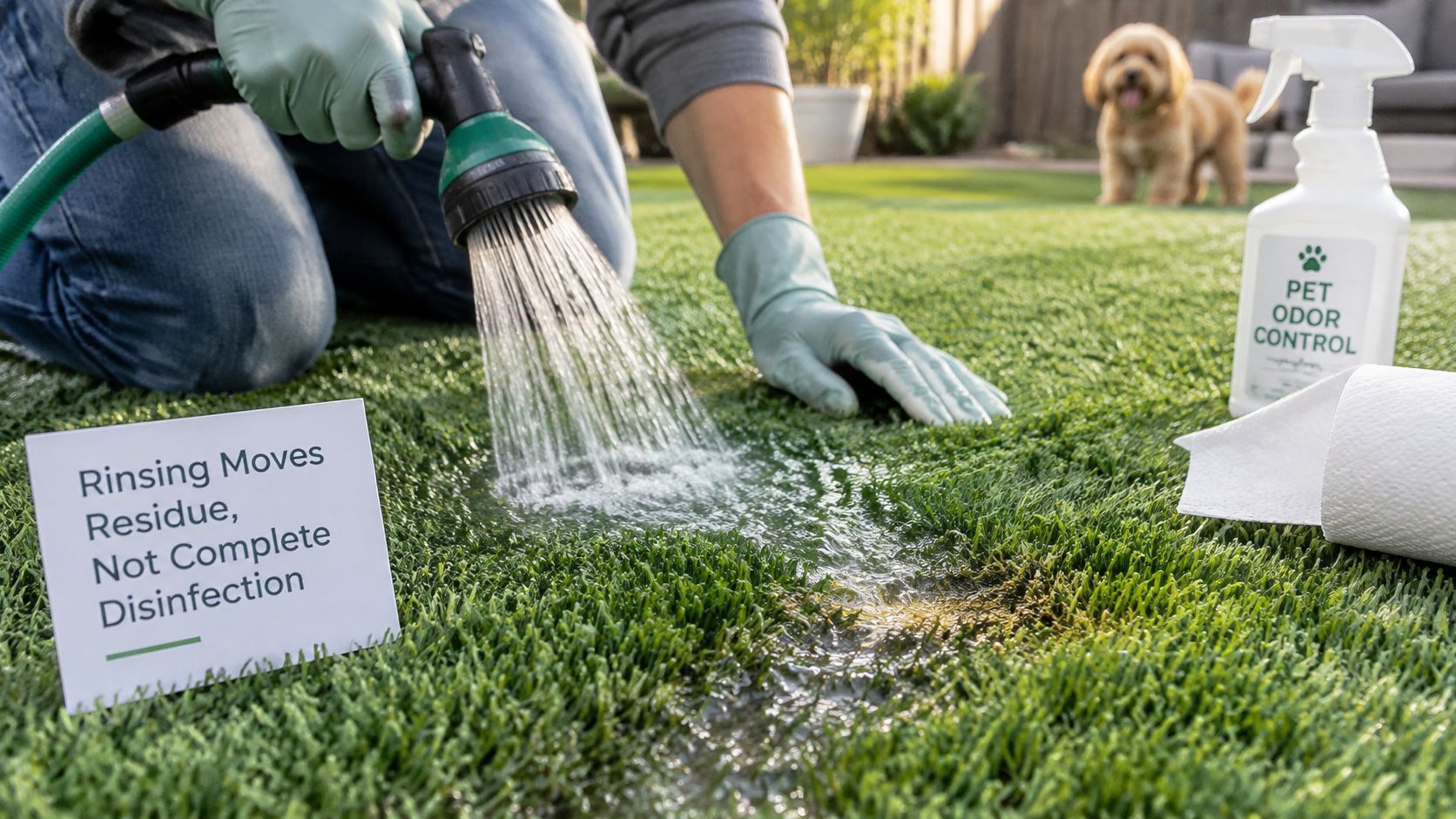
Rinsing moves urine and dissolved residue down through the pile. It doesn't necessarily disinfect the infill or strip out organic material that has already collected there, which is why a yard can smell worse a day after being hosed. A municipal review of synthetic turf notes that pet waste can build up, that the surface needs rinsing after pet use, and that severe buildup may call for infill removal or vacuuming plus a purpose-designed cleaner. That review also cites independent veterinary research which found enteropathogens in 38% of sampled dogs across three Northern California dog parks, with no statistically significant difference between artificial and natural grass parks.
That finding reframes the job. Pathogen management is the goal on any surface, grass or synthetic, and a yard that smells fine hasn't proven anything about what's living in the infill.
Here's the rinse and brush pass in motion, which is easier to copy than to describe.
Work through the tiers in order
Solids and a deep rinse. Lift waste without smearing it, then soak the urine spot until water reaches the drainage layer and let it go. Most days, this is the entire job.
A compatible enzymatic cleaner. For odor that lingers after a correct rinse, apply only a manufacturer-approved or enzymatic product, follow its contact time and pet re-entry instructions, and never mix it with anything else in the same sprayer.
An inspection, not another bottle. Odor that returns within days of two proper cleanings is coming from the infill, the backing, the slope or the drainage. Cleaning the top of the surface again won't reach any of those.
Match the pattern you're noticing to the likely cause before you buy anything.
| Odor pattern | Likely cause | Next step |
|---|---|---|
| Smell after rain that fades when dry | Organic matter trapped in infill | Brush, rinse, then check drainage |
| Strong smell right after pet use | Urine not rinsed deep enough | Rinse thoroughly, then use an enzymatic cleaner |
| Smell returns within days of cleaning | Residue in infill or backing | Inspect infill and backing; consider infill removal or vacuuming |
| Pooled water with a smell | Slope or base drainage failure | Have the base and slope inspected |
| Smell only in one shaded corner | Low spot that holds moisture | Rinse that spot more often and check for low areas |
Odor control and disinfection are different jobs, and a deodorizer that masks a smell is worse than useless because it hides the signal you need. If you're building a dog run or replacing a worn one, the guide to artificial grass installation for dogs covers what a surface needs underneath to stay clean. In Indianapolis the shoulder seasons do the damage: freeze-thaw cycles, heavy spring rain and weeks of mud expose drainage weaknesses that no surface rinse will fix, and that's usually the moment a two-year-old odor problem becomes obvious.
Products to Avoid and When to Clean
The most expensive mistake in turf care is buying a cleaner before removing the debris. Solvent-type products, household all-purpose sprays and abrasive pads have no place on the pile, and neither does a routine dose of fungicide or antibacterial spray, which chases a problem sunlight usually handles and can carry residue into stormwater. Keep the boundary simple: water and a brush for ordinary dirt, a labeled product for one specific organic odor.
Use this as the short list you take to the store.
| Product or method | Use for ordinary cleaning? | Notes |
|---|---|---|
| Plain water rinse | Yes | Default for dirt, pollen, dust and urine |
| Manufacturer-approved enzymatic cleaner | Yes, for organic odor | Follow the label's contact time |
| Diluted mild soap | Spot test first | Rinse thoroughly afterward |
| Bleach or chlorine products | No | Not recommended by most manufacturers |
| Solvents or general-purpose cleansers | No | Guidance says not for ordinary cleaning |
| Fungicide or antibacterial sprays | No, unless the manufacturer directs | Can contaminate stormwater |
| Pressure washer | Only if the manufacturer allows | Check the manufacturer's pressure limits first |
Time the work around the heat
Synthetic turf in direct sun runs roughly 40 to 70°F hotter than natural grass, according to a municipal sustainability review of natural and synthetic turf, which also cites a government presentation reporting differences as large as 59°F. That changes when you work. Clean in the early morning or after the sun drops, and put the back of your hand on the surface before kids or dogs go back out. Hot water also changes how the pile feels underfoot, so test a small patch before soaking a whole area.
Runoff is the other thing most cleaning advice ignores. Rinse onto the turf, not across the driveway, and keep soapy water and cleaner residue out of storm drains and adjacent soil. The same review identifies PFAS in some turf components, with newer materials showing higher concentrations in some cases, and notes that evidence is still insufficient to determine human health risk or how much leaches during ordinary use. Ask your installer for product-specific material and drainage documentation rather than assuming either answer.
Plain water and a brush handle nearly every job on that list. A labeled product is for one thing only: an organic odor that survived a proper rinse.
Spills and Stains by Type
Spills don't wait for the schedule. The rule covering all of them is short: get the solids off, rinse with water, and reach for a product only when the job needs one. What changes between them is the order of operations and the tool.
| Spill type | First action | Avoid |
|---|---|---|
| Mud or soil | Let dry, brush out loose material, then rinse | Scrubbing wet mud into the fibers |
| Food or sugary drink | Rinse with water soon after the spill | Letting sugar dry in the infill |
| Oil, grease or paint | Scrape solids, blot, spot-test mild soap | Solvents and general-purpose cleansers |
| Chewing gum | Harden with ice, lift with plastic scraper | Scraping with metal tools |
| Vomit or blood | Remove solids, rinse deeply, enzymatic cleaner if odor remains | Bleach or chlorine products |
Mud and soil. Let it dry completely, then brush the loose material out before rinsing. Scrubbing wet mud pushes grit down into the pile and grinds it against the backing.
Food and sugary drinks. Rinse soon after the spill, while the sugar is still liquid. Left to dry, it glues fibers together at the base and invites ants and mold into the infill.
Oil, grease and paint. Scrape the solids off with a plastic tool, blot what's left with cloth, then spot-test diluted mild soap somewhere nobody looks and rinse thoroughly. Solvents stay in the garage.
Chewing gum and tree sap. Do the opposite of what instinct says. Harden it with ice until it turns brittle, then lift it with a plastic scraper. Pulling it while soft drives it deeper into the thatch.
Vomit and blood. Remove the solids, rinse thoroughly enough to reach the base, and use an enzymatic cleaner only if odor remains, watching its stated contact time.
Spot-test anything new, including hot water. A patch behind the shed tells you more in five minutes than a label does.
After any treatment, let the area drain and check the spot again once it's dry, because residue and smell show up after the water leaves, not while it's still sitting there.
Decide When DIY Cleaning Stops Working
Routine upkeep on a pet yard or a sports surface is an occasional rinse, leaves and debris cleared, and light brushing where feet land most. No mowing, no fertilizing, no chemical program. That's the whole job when the base underneath is right.
The five signs that point below the surface
Odor that returns within days of two correct deep rinses. The residue is sitting in the infill or the backing, where a hose can't reach it.
Water that pools for hours after rain. Porous carpet doesn't guarantee drainage; the base, the slope and the discharge route do the work. A properly built sports surface stays playable after rain instead of turning to mud or puddles, so standing water points to the build.
Lifted seams or loose edges. Once an edge pulls, grit gets under it and the repair grows every week you leave it.
A hard patch underfoot where the pile has compacted and no longer springs back after brushing.
Visibly thin infill along the traffic paths, which is exactly where puddles and odors both begin.
Every one of these is a base, slope or drainage problem, and no cleaner on a shelf will fix it. The explainer on the artificial grass base layer shows what a properly built profile looks like: excavated soil, compacted crushed stone or decomposed granite, a weed barrier, tight seams and infill at the right depth. It's why Waterloo Turf Indianapolis doesn't install turf directly over soil. Without that base, water has nowhere to go and brushing the surface will never change it.
A professional check covers base condition, drainage slope, seam tightness, infill depth and where water goes once it drains. If the same complaint comes back after two correct cleanings, book that check before you spend on a stronger product.
Start a log today. Note the date of each rinse and brush, the weather that week, and which task you keep repeating. Thirty days of notes will tell you more about what's under the turf than any cleaner label ever will.
A surface that's clean on top and still smells or ponds after rain has a problem underneath. Waterloo Turf Indianapolis designs and installs synthetic grass for pet yards, play areas and commercial properties across the Indianapolis metro, including Avon, Carmel, Fishers and Zionsville, built on a compacted stone base that gives water somewhere to go. For surfaces that need more than a home routine, the company offers a Fresh'n Clean maintenance membership. Visit Waterloo Turf Indianapolis to talk through what your surface needs.