Artificial Grass Installation for Dogs: Step-by-Step Guide
Plan artificial grass installation for dogs with the right base, drainage, backing, infill, heat control and cleaning routine. Step-by-step guide.
Your dog run looked fine in April. By midsummer the corner by the gate is slick, the smell hits before the door shuts, and the afternoon sun turns that patch into a hot plate. That is what happens when artificial grass installation for dogs is treated like laying a carpet. The blades are the easy part. The job that lasts is a drainage and heat system: a compacted base that moves urine and rinse water, a backing that lets liquid through, and a use plan for the hours when the surface gets dangerous.
I would not order turf until three numbers are written down. How fast water leaves the high-use spots, which way the ground falls, and how many hours of direct sun hit the run after lunch. Those three decide the base, the infill, and whether your dog should be outside at 2 p.m.
Assess Drainage, Slope and Sun Before You Order
Say the run looked solid in spring because the grass was still green and the soil still held together. By July the same four spots your dog uses every day are muddy, sour, and slow to dry. Nobody checked the subgrade. The turf never had a chance.
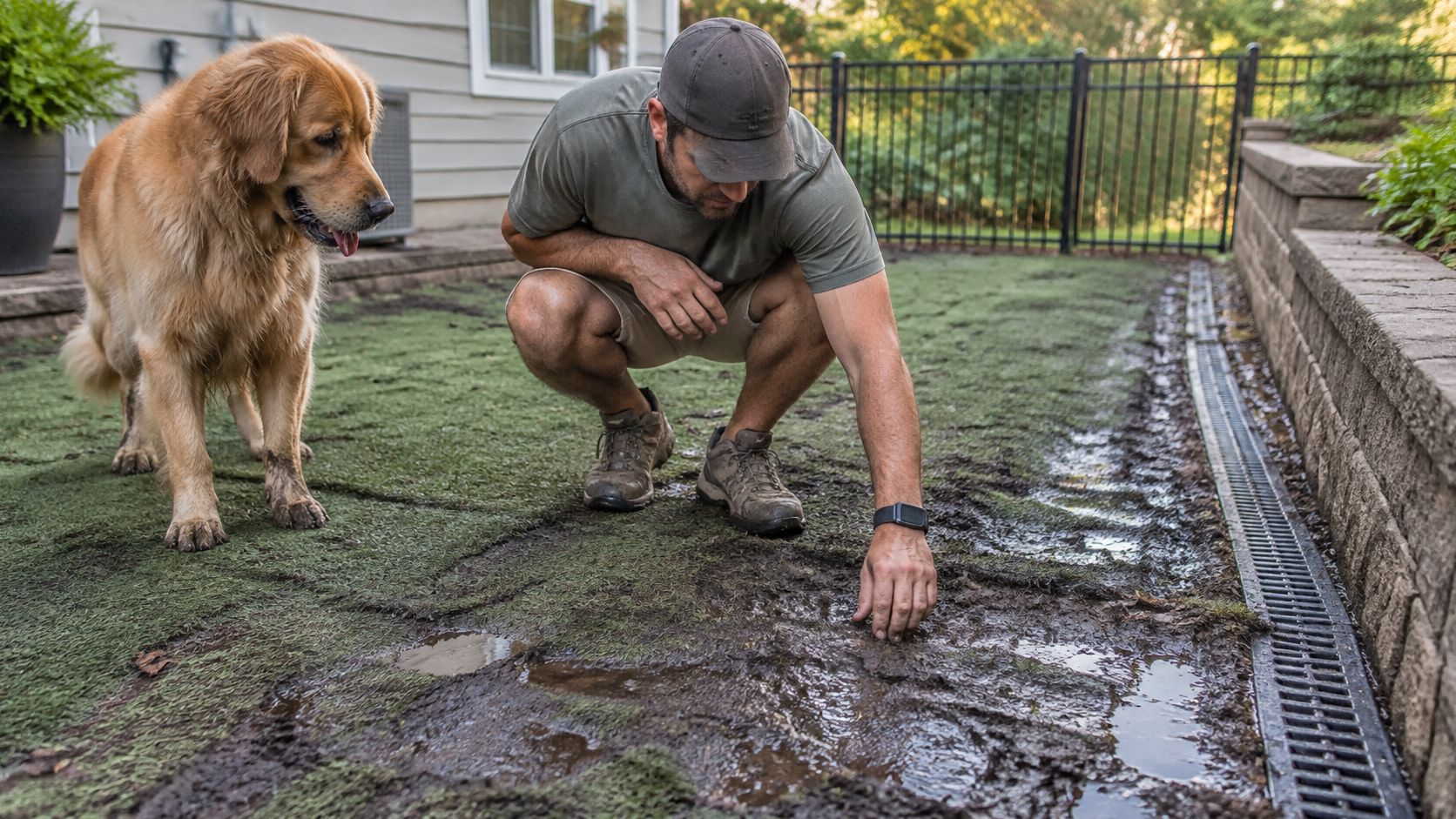
Soil comes first. Clay and a compacted subgrade hold water and urine. Sandy soil clears faster, but it needs a firmer base or the surface rocks under paws. Dig a small test hole in the favorite corner and squeeze a handful. If it ribbons like pottery clay, plan on a free-draining stone base and a real outlet, not a hope that the yard will soak it up.
Then find the low spots. After the next rain, walk the run and mark every place water sits. You want a steady fall of about 1 to 2 percent toward a drain, a gravel daylight strip, or another approved outlet. A flat pocket under the backing is where odor starts. Grading by eye is how those pockets get built in.
Time a bucket. Pour a measured bucket on the high-use zone, the door, the gate, and the favorite corner. Watch how long it takes to clear and whether it runs sideways instead of down. Write the time next to each spot. A slow clear on clay is a warning, not a detail to fix with more infill later.
Sun, the dog, and what is buried
Note which sections take full afternoon sun, especially south- and west-facing fence lines. That map is where shade and a cooler retreat have to go, not an afterthought once the turf is down.
The dog changes the build too. A digger needs buried edges that will not lift. A senior dog needs a cushioned, even base with no soft dips. A short-nosed dog needs stricter summer hours, because heat hits those breeds harder.
Before any digging in the US, map irrigation lines and call 811. Marking only the grass edge you can see is how a trencher finds a line.
Write three numbers before you order: drainage time at the worst spot, the fall toward the outlet, and hours of direct sun after noon. You and the installer should be looking at the same baseline.
Choose Backing and Infill That Hold Up to Dogs
Infill has two jobs. It holds the fibers upright, and it either helps liquid leave or traps what your dog leaves behind. The brochure version of "pet infill" skips the second job. Match the material to how many dogs you have and how often you will rinse.
| Infill type | Drainage and cleaning | Odor handling | Trade-off |
|---|---|---|---|
| Silica sand | Drains well when clean; packs down over time | Limited alone; rinsing does the work | Low cost and common, but needs regular rinsing |
| Zeolite-blend infill | Drains well; can be raked and rinsed | Adsorbs odor compounds | Often blended with sand; costs more than plain silica sand |
| Antimicrobial-treated sand | Drains like sand | Slows bacterial odor | Coating wears; check how long it lasts |
| Crumb rubber | Holds moisture and debris | Can hold odor | Often avoided in dog areas because it runs hotter |
How to pick for your dogs
One calm dog and a hose you will use. Clean silica sand is a fair baseline. It is inexpensive and it drains while it stays loose. Heavy urine packs it. If you rinse the same two corners most days, sand can work. If those corners get a rinse only on weekends, sand will smell before the season is over.
Odor is already the complaint. A zeolite blend is the better call. Zeolite adsorbs odor compounds instead of only letting liquid pass. It is usually mixed with sand so the price stays reasonable and the surface still brushes clean. Rake and rinse it. Do not expect the mineral to replace the hose.
You want a slower smell between rinses. Antimicrobial-treated sand drains like ordinary sand and slows bacterial odor. Ask how long the coating is rated to last, because it wears off under traffic and rinsing. If the installer cannot name a service life, treat it as sand with a head start, not a permanent fix.
Skip crumb rubber in the run. It holds moisture and debris, it can hold odor, and it runs hotter than mineral infill. That is the wrong stack for a spot a dog stands on at midday.
Backing and the real schedule
Choose a perforated or fully permeable backing with real open area, not a solid sheet with a few holes. Urine has to pass across the whole high-use zone, not hunt for a drain hole a foot away. A pet-turf infill guide is worth reading before you lock a spec, because the infill weight and the backing have to work as one layer.
Three dogs in a daily run are not one dog with a rinse habit. More dogs mean more ammonia in the same square feet, so zeolite or a treated sand earns its cost. One dog with a daily hose can stay on clean sand if you will keep that promise.
Pick the infill you can clean on your real week, not the one with the best label. A zeolite blend you never rinse still fails. Sand you rinse every evening often does not.
Excavate and Build a Drainage Base, Step by Step
A dog run is a sanitation system. The Western Resource Advocates artificial turf report is clear that pet waste can sit on synthetic turf and that pet-specific infills do not remove the need to rinse. On Indianapolis-area clay, a compacted subgrade, or a tight run, urine and rinse water stay trapped under the backing if the whole stack never gets a flow test.
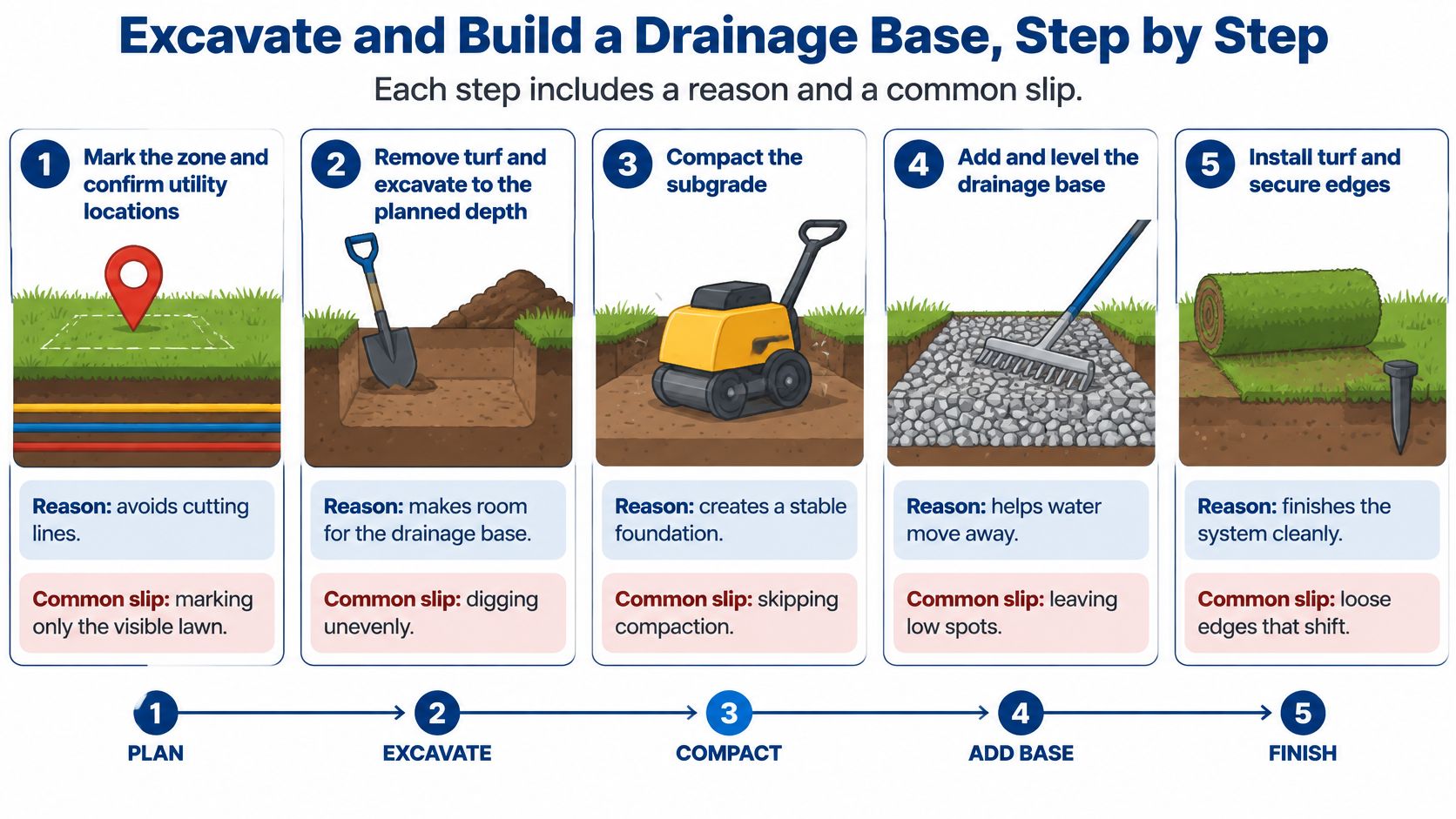
The same base discipline shows up on a backyard putting green install. Dog traffic is harsher because the liquid is concentrated, but the order of work is the same idea. Build down, then lay the surface.
The sequence, with the slip that ruins it
- Mark the zone and confirm utilities. You avoid cutting a line. The slip is marking only the lawn you can see and missing irrigation just inside the fence.
- Excavate about 3 to 4 inches (75 to 100 mm). Pull sod, roots, and organic soil. Organic material decays and sinks, and it holds moisture. The slip is leaving topsoil in the low spots because "it is only a little."
- Grade a consistent fall toward the outlet. Water needs a direction. The slip is grading by eye, which leaves flat pockets the dog will find.
- Place crushed stone or decomposed granite in lifts of about 1 inch and compact each lift. A loose base settles into dips under paws. The slip is one heavy pass at the end, which looks firm on top and stays soft underneath.
- Lay a weed barrier with overlapped seams. It stops growth through the base. Leave no gaps at the edges, or grass comes up beside the nailer board.
- Roll perforated turf, keep seams tight, and pin the edges. Loose edges let a dog lift the turf. The slip is stretching it in the heat so it buckles when it cools.
- Spread infill at about 1.5 to 2 lb per square foot (7 to 10 kg/m²) and power-brush the fibers upright. Thin infill mats. Thick infill can slow the first pass of water if it is packed.
- Repeat the bucket test on the finished surface at the high-use spot and the low point. Time it. Note ponding or water running sideways under the backing.
If that test is slow, do not add more infill and hope. Add a perforated collection pipe, a graded channel, or a daylighted outlet. Infill cannot drain a sealed clay bowl.
What each layer has to prove
| Layer | Typical depth or spec | Job in a dog run | Check before moving on |
|---|---|---|---|
| Excavation | 3–4 in (75–100 mm) | Removes sod and organic soil that decays and holds moisture | Subgrade free of roots and soft pockets |
| Crushed stone or decomposed granite base | About 3–4 in, compacted in 1 in lifts | Stable, free-draining layer that carries water to the outlet | Firm underfoot, no rocking under the compactor |
| Weed barrier | Single layer, overlapped seams | Stops growth through the base | Seams overlapped, no gaps at edges |
| Perforated turf backing | Per product specification | Lets rinse water and urine pass through | Water clears through the backing in the field test |
| Infill | About 1.5–2 lb/sq ft | Keeps fibers upright and supports drainage | Even coverage, fibers stand after brushing |
A good result is simple to feel. Water clears within minutes, nothing ponds, and there is no soft spot under your shoe. Our installs follow that full stack, from excavation through a compacted crushed stone or decomposed granite base, weed barrier, tight seams, secure edges, infill, and a final power brush. The strong base is also what keeps dogs from digging the turf up at the fence.
If infiltration fails the bucket test, fix the outlet before the dog walks on it. Pulling infill back up to add a drain is the expensive version of a step you skipped.
Manage Surface Heat and Set Dog Access Hours
A run can drain perfectly and still burn paws in July. Good drainage does not make a dark surface safe at midafternoon.
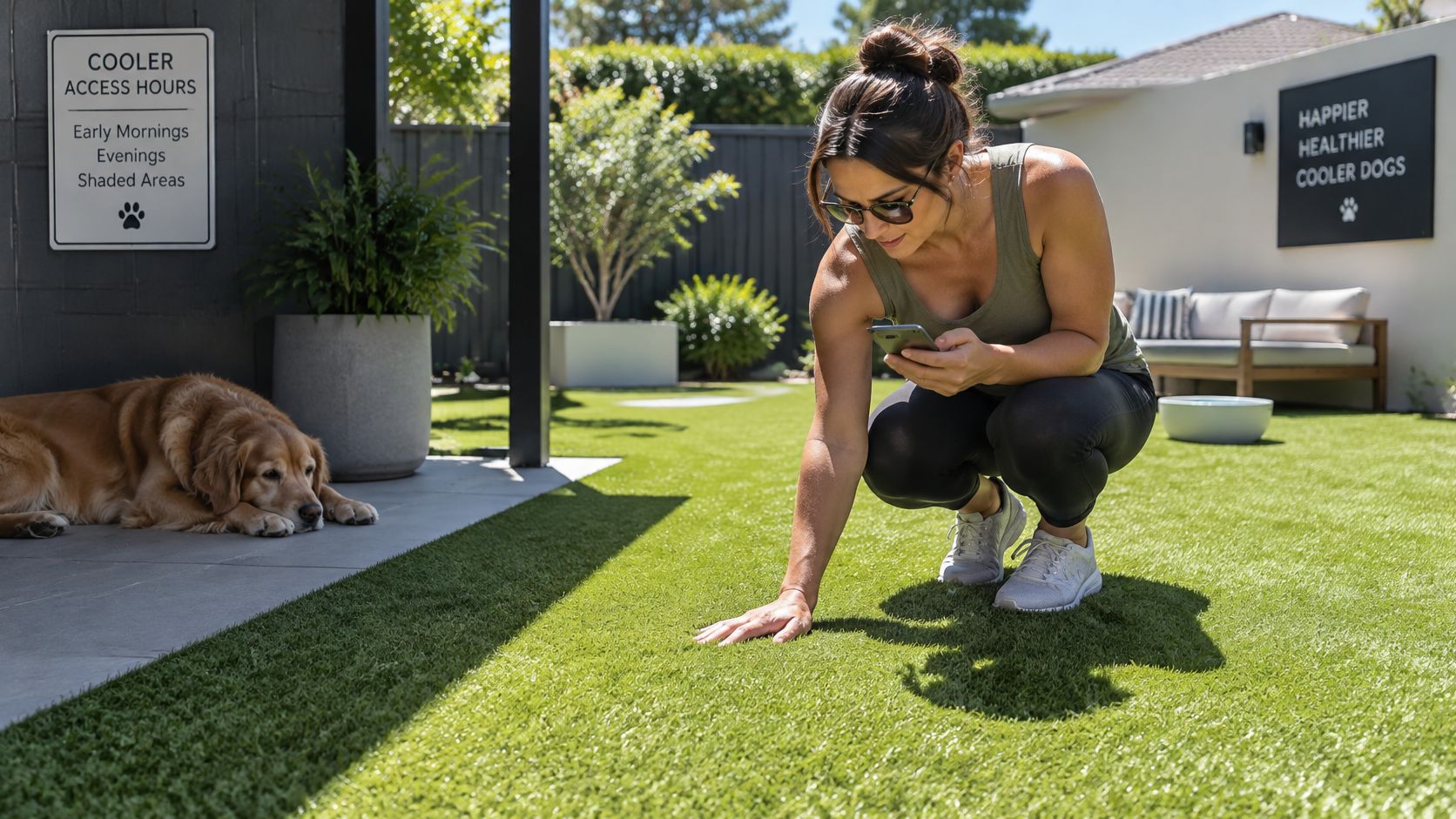
In a university comparison of six outdoor surfaces, artificial grass was the hottest surface in all four trials, and artificial grass, asphalt, and running-track material exceeded 50 °C (122 °F) at about 2 p.m., a temperature that can severely burn paws within minutes, according to Vets Now guidance on hot surfaces. A separate field assessment in that same guidance found artificial-turf hourly mean temperatures reaching 71.6 °C and sitting above a 48 °C burn threshold for almost four hours, while natural turf stayed under that threshold in the test. South- and west-facing Indianapolis yards with dark infill and little shade are exactly that problem.
Plan the sun before you lay the first roll
Walk the sun path on a clear afternoon and mark the zone the dog uses. Put shade from a tree, a sail, or a simple structure over that zone if you can. Avoid a layout boxed in by a dark fence that traps heat. Lighter mineral infill stays more tolerable than dark rubber. Polyethylene blades are the usual pet-turf fiber because they stay softer and take less moisture than nylon. A closer look at polyethylene artificial grass helps when you are comparing face yarns, but the yarn does not cancel radiant heat. A pet-safe label does not either.
Our pet turf uses heat-resistant materials that help it stay cooler than traditional synthetic surfaces, and it is UV-resistant and cushioned. That is a material choice, not a promise of unrestricted summer access.
A daily access routine
Test with the back of your hand before you open the door. If you cannot keep your hand there comfortably, your dog stays in. Paw boots do not replace that check.
- Shift the hours. Early morning and evening in summer. Skip the window around 2 p.m.
- Give a retreat. Shade plus fresh water, not a single sunny square.
- Wet the surface before use if you must go out. Wetting helps for a short time, then the sun wins again.
- Tighten the rules for senior dogs, short-nosed breeds, overweight dogs, and dogs with heart or breathing trouble.
This short clip shows why a hand test beats guessing from the air temperature.
I would rather restrict two hot hours a day than explain a burned pad. Write the rule on the back door if more than one person lets the dog out.
Odor Control and Routine Cleaning Schedule
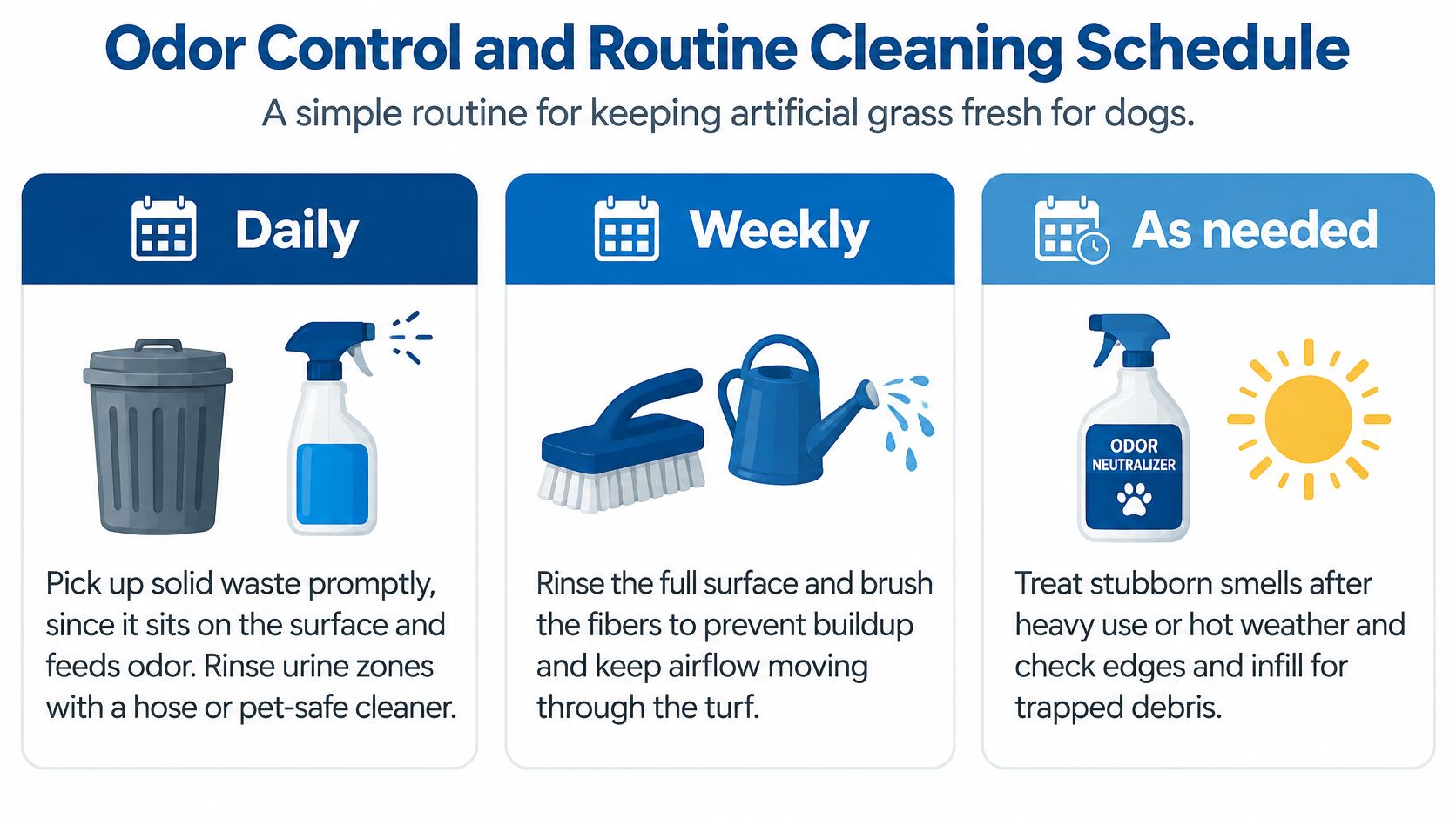
The base moves liquid. The schedule keeps bacteria from owning the fibers. Pet turf needs almost no irrigation, only an occasional rinse to clear waste, plus light brushing where traffic mats the pile. Solid waste picks up the same way it does on natural grass.
The rhythm that actually works
- Daily: Pick up solids right away. They sit on the pile and feed odor. Rinse urine zones with a hose until the water runs clear, not until the surface merely looks wet.
- Weekly: Brush fibers upright in the high-traffic corners so air and water can reach the backing. Check the drain outlet for leaves and grit.
- Monthly: Deep-clean with an enzymatic cleaner made for synthetic turf. Enzymes break down organic residue. Perfumed sprays only cover it.
- Seasonally: After heavy rain, check infill depth and top up where it washed toward the outlet.
Skip bleach and ammonia cleaners. Ammonia smells like urine to a dog and can invite more marking. Bleach can damage fibers. Kneel and smell the run in the morning, before the first rinse. That is the honest test. If it is sour then, the evening rinse is not reaching the spot.
Three failures and the fix
One corner always smells. You are rinsing the middle and missing the fence line. Add a second hose pass on that zone every day until the morning smell is gone.
The favorite spot feels hard and the blades lie flat. Infill has packed. Rake it loose, top it up to an even layer, and brush the fibers up again.
Water sits after a rinse that used to disappear. The outlet is clogging. Clear debris, flush the line with a hose, and time a bucket again. If it is still slow, the base or the pipe is the problem, not the cleaner.
With that routine, pet turf keeps its look and function for well over a decade. Skip the rinses and the same turf can smell like a sewer by the second summer, no matter how good the backing was on day one.
Confirm the Build Before Your Dog Walks On It
Do not let the dog on the new surface until the run passes a go or no-go check. Drainage problems are costly once infill is down, because you are digging through a finished yard to reach a pipe you should have proved on install day.
Pass all of these, or wait:
- Drainage test passed at the high-use spot and the low point, with no ponding.
- Base is compacted, firm underfoot, no soft pockets.
- Seams are tight and edges are pinned so a paw cannot get under them.
- Shade and fresh water are in place for the first hot week.
- Hose, brush, and enzymatic cleaner are already in the garage.
A professional pet-turf install follows the full sequence: excavate existing grass and soil, install and compact crushed stone or decomposed granite, add a weed barrier, lay turf with tight seams, secure the edges, apply infill, and finish with power brushing. Ask for the drainage times and the base depth in writing. Customers pick an installation date after the quote, and then the crew installs. That order only helps if the quote already names the outlet, the fall, and the infill.
Budget the stack, not a single number
A 2025 SitePrep pricing guide estimated quality pet-turf installation at $12 to $20 per square foot, with typical spending of $14,000 to $16,000 for a 1,000-square-foot area (SitePrep). Ask each quote to itemize excavation, base, drainage, and infill so you can match the price to the bucket-test results. A cheap number that skips the outlet is the muddy July you started with.
This week, take your three yard numbers, drainage time, slope, and sun hours, to an installer and ask for a written drainage plan before any work starts. I would not accept a quote that cannot show where the water leaves.
Waterloo Turf Indianapolis designs and installs pet turf across the Indianapolis metro, with a compacted base, permeable backing, and pet-focused infill built for dog runs rather than a carpet laid on soil. If your run needs a drainage plan that accounts for clay, urine load, and summer heat, bring your site notes and schedule a look at the yard. Start with Waterloo Turf Indianapolis.