Artificial Turf Infill: Types, Amounts and Maintenance
Compare rubber, sand, hybrid and organic artificial turf infill for lawns, pets and sports, with installation amounts and maintenance tips.

If two artificial lawns use the same grass, why might one feel firm and drain cleanly while the other feels uneven and smells after the dog uses it? The difference may be underneath the blades, in the artificial turf infill, the backing, or the base beneath them.
Infill isn't just something an installer spreads at the end. Choosing it means deciding how the surface should feel, what maintenance you'll accept, how water and pet waste will move through the system, and what you'll do with the materials when replacement becomes necessary.
Infill Types Compared and Their Trade-offs
Infill is a working layer that holds the blades upright and shapes the feel of the surface, not just a filler. Think of the available materials as different tools rather than interchangeable bags of granules.
The New York State Department of Health's synthetic turf fact sheet explains how longer-fiber turf systems incorporated rubber or rubber-and-sand infill to support fibers and improve resilience, with tire crumb typically produced as granules approximately 2–3 millimeters across. That engineering role matters more to a buyer than the material's color.
Artificial turf infill types compared
| Infill type | Main material | Where it is most used | Key trade-off |
|---|---|---|---|
| Crumb rubber | Recycled tire granules | Sports fields and playgrounds | Heat retention and rubber odor in hot weather |
| Silica sand | Natural sand, sometimes coated | Residential lawns and older systems | Heavy and stable, but can compact and provides less bounce |
| Hybrid | Sand base with a rubber or polymer top layer | Sports and high-traffic areas | Higher cost and more layers to specify |
| Organic | Cork, coconut fiber or walnut shell | Pet areas and eco-focused yards | Breaks down over time and needs replenishment |
What the trade-offs mean underfoot
Crumb rubber verdict: A candidate when resilience and active play matter, provided you're comfortable with the material's heat, odor, maintenance, and documentation requirements.
Rubber granules compress differently from mineral sand. That makes them useful in performance-oriented systems, but rubber infill alone doesn't establish that a playground has adequate fall protection. The complete surface, including any cushioning underneath, needs to suit the activity.
Silica sand verdict: A practical stabilizing material when firmness and fiber support matter more than a springy feel.
Choose purpose-made turf infill rather than substituting construction sand or a bag of play sand. Cleanliness, grain shape, and consistency affect how it settles between the fibers. A coated sand is also a distinct product, so don't assume every sand-based option has identical dust or surface characteristics.
Hybrid verdict: Useful when you need separate control over stability and cushioning, but the installer must specify the layers rather than treating them as an improvised mixture.
Ask which material goes underneath, which belongs above it, and how installation will be checked. More components create more opportunities for a mismatch between the quoted system and the installed surface.
Organic verdict: Worth considering when plant-derived materials are a priority and you're prepared to manage moisture and replenishment.
Natural doesn't automatically mean maintenance-free, odor-free, or appropriate for intensive dog use. Cork, coconut fiber, and walnut shell aren't interchangeable, either. Evaluate the actual product and its care instructions.
Buying principle: Compare the cost of keeping the surface functional, not just the cost of the first bag.
No single type is best for every yard, pet run, or field. A less expensive material isn't a bargain if it moves out of place, feels wrong for the activity, or demands maintenance you won't perform.
What Infill Does Inside a Turf System
Say you're planning a backyard with a seating area and an open strip for play. You want the whole lawn to look consistent, but the play strip will receive more footsteps and turning movements than the edges.
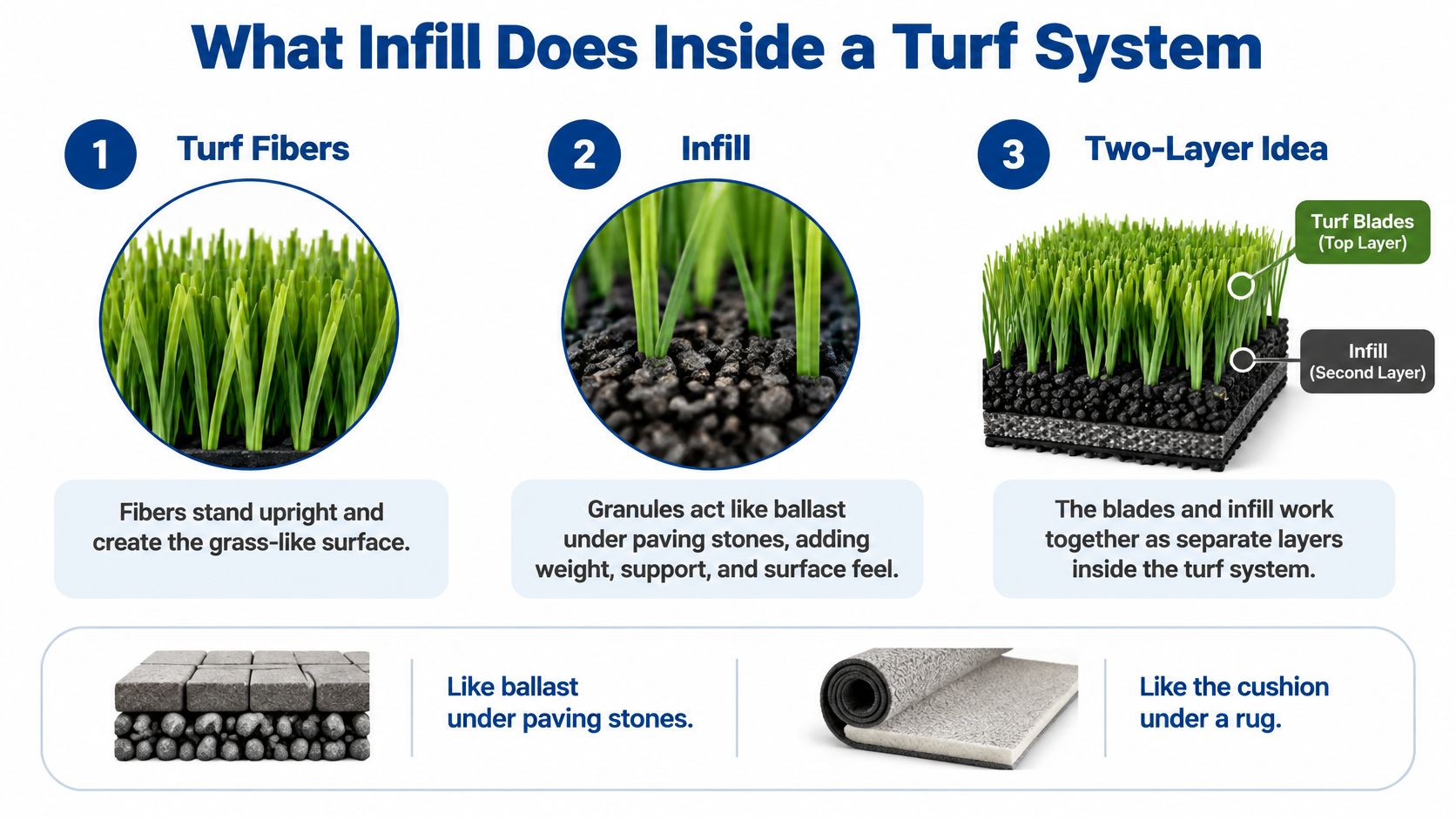
Infill works a little like ballast under paving stones and a little like cushion beneath a rug. It adds weight and support, while its material and arrangement help determine what you feel through your shoes. Unlike paving ballast, however, it sits between flexible fibers, not beneath a rigid surface.
The diagram separates the visible grass from the material working around its base.
Separate support from cushioning
In a layered system, the lower sand layer provides stabilization. A resilient upper material, such as styrene-butadiene rubber, commonly shortened to SBR, adds a different mechanical response. SBR is a type of synthetic rubber.
Not every residential installation needs this arrangement. The useful distinction is between holding the turf fibers in position and providing the desired surface response. Those jobs can involve different materials, and a soft-feeling sample doesn't tell you whether the completed system will perform properly.
Particle size also changes how the surface behaves. Larger or more angular granules may resist movement but feel different underfoot. Excessively fine material can fill the open spaces that water needs, while insufficient infill can leave fibers without enough support.
Follow the water below the grass
Water must pass through more than the visible infill. The backing needs to allow passage, the base needs to receive and convey water, and the site needs a suitable drainage route.
A permeable turf sample won't fix a depression in the base. Similarly, adding more infill won't correct water flowing toward a building instead of away from it. For an Indianapolis backyard, inspect downspout outlets, adjoining paving, and low boundaries during planning rather than after the lawn is installed.
Keep an installation record with these details:
- Material identity: Record the infill product and any separate layers.
- Particle specification: Save the stated grain-size range and product sheet.
- Installed quantity: Keep delivery records and the amount applied.
- Drainage route: Note where water passes through the system and where it ultimately goes.
That record gives a future maintenance contractor something more useful than a photograph of green grass. It also makes it easier to distinguish a material problem from a base or drainage problem.
Matching Infill to Pets, Yards and Sports
Start with what people or animals will do on the turf. A lawn viewed from the kitchen window places different demands on infill than a dog's regular bathroom area or a training lane.
A family backyard needs comfortable, stable footing
For a general lawn, prioritize a comfortable surface, limited loose dust, and fibers that remain supported along walking routes. Sand-based infill may suit that demand; a compatible resilient component may be appropriate where the specified system calls for a softer response.
Test a sample with the shoes you'll wear outside, not just with your hand. Pressing a display sample with your fingers doesn't reproduce walking, kneeling, or a child changing direction during play.
Also consider sun exposure. Don't assume that choosing a particular infill makes a synthetic surface comfortable at every temperature. Check the surface before barefoot play, and plan shade where people will spend time.
Choose for the busiest part of the space, not the quietest corner.
A dog run needs a sanitation plan
Urine management requires a complete drainage and cleaning system, not an infill marketed for pets alone. Select the backing, base, infill, and rinsing access together.
An antimicrobial treatment isn't a replacement for removing solid waste or rinsing urine residue. Ask what the treatment is intended to protect and what its documentation supports. Avoid turning a product claim about the material into a promise about animal health.
Organic infill may be a candidate for lighter-use spaces, but don't choose it solely because it's natural. Check whether the product's moisture behavior and replacement requirements suit the site. For a heavily used dog run, favor a documented pet application and a cleaning routine that the owner or site manager can realistically maintain.
- Access: Can a hose reach the entire run?
- Waste handling: Can someone promptly collect solids without digging into the infill?
- Discharge: Where will rinse water travel?
- Animal behavior: Does the dog dig, chew, or pick up loose materials?
Sports surfaces need predictable performance
Players need consistent traction, ball response, and impact behavior. Rubber and hybrid systems are candidates, but the sport should determine the specification, not a generic preference for extra cushion.
A putting surface also needs its own material selection. Sand that works in tall grass fibers shouldn't automatically be used in short, dense putting turf.
Match particle type, application rate, and maintenance to pile height, traffic, drainage, and the intended feel. Pile height means the length of the turf fibers. The loading rate and care plan should support that specific combination.
How Much Infill Each Project Needs
Infill reference amounts by application
| Application | Reference figure | Source basis |
|---|---|---|
| Full sports field | About 400,000 lb of infill, compared with about 40,000 lb of turf materials | California background estimate discussed in the federal tire-crumb information summary |
| Sand infill, lab test range | 0–35 kg/m² tested; ball deceleration leveled off near 10 kg/m² | Laboratory study of sand-filled synthetic turf |
| Sand infill, best range for tested surface | Use the tested surface's operating range only for that surface, not as a residential specification | Same laboratory study |
| Residential lawn | Measured turf area multiplied by the specified product loading rate | Confirm with supplier and site measurement |
| Pet run | Measured turf area multiplied by the pet-system loading rate | Confirm with supplier loading rate |
A full field involves substantial material handling. The field estimate above shows why infill affects delivery access, storage, installation labor, and eventual removal, not just surface feel.
It isn't a calculator for your backyard. Field dimensions, pile construction, infill density, and the intended activity all change the requirement. A field-wide total can't be scaled down responsibly without knowing the underlying specification.
More infill doesn't simply mean more softness
In the sand-filled laboratory surface, adding infill increased hardness while reducing ball rebound and rotational resistance. Rotational resistance describes how strongly the surface resists a turning movement, such as a planted foot twisting.
Those findings challenge the assumption that adding material always makes turf softer or safer. Sand can stabilize a surface while making it feel firmer. Leaving too little exposed fiber can also produce a different result from the one the system designer intended.
The study's preferred operating range balanced performance with exposed fiber length for the particular surface tested. It doesn't establish a universal residential or pet-turf loading rate.
Calculate from the product specification
Use this quantity logic:
Turf area × written loading rate = required infill weight
Then divide the required weight by the weight per bag and round up to whole bags for purchasing. Keep any installation allowance separate from the specified amount that must end up in the turf.
- Measure the footprint: Divide irregular spaces into manageable shapes and exclude areas that won't receive turf.
- Identify the exact system: Record the turf model, infill product, and any layered arrangement.
- Get the rate in writing: Confirm the units and whether the rate applies to each layer or the combined installation.
- Verify the result: Compare installed weight and representative depth checks with the specification.
For a golf project, include infill selection in the putting green installation plan, alongside contours and intended ball roll.
Keep the area measurement, product sheets, delivery quantities, and completion checks together. That creates a useful baseline when deciding whether a later thin area needs redistribution or additional material.
Keeping Infill Level, Clean and Draining
Use this as a starting maintenance schedule, then adjust it to actual traffic, leaf fall, pet use, and the turf manufacturer's instructions.
Infill maintenance schedule
| Task | How often | Why it matters |
|---|---|---|
| Remove leaves and debris | Weekly in leaf season | Stops debris holding moisture on the surface |
| Rinse pet areas | Weekly or after heavy use | Reduces odor and residue in the infill |
| Power brush to redistribute infill | Monthly in high-traffic zones, where approved for the turf | Keeps fibers upright and infill even |
| Check infill depth or weight | Yearly, or when low spots appear | Catches low areas before fibers mat |
| Test drainage after heavy rain | After storms | Confirms infiltration isn't slowing |
Clean before redistributing
Remove leaves, twigs, and loose waste before brushing. Otherwise, you can work debris down into the infill instead of removing it.
Use a leaf rake with turf-safe tines or a blower on a gentle setting. Direct debris toward a collection point, not into planting soil or a storm drain. For brushing, use equipment approved for the installed turf and avoid aggressive settings that pull fibers or disturb seams.
Contamination isn't merely cosmetic. Dirty infill can retain water and interfere with surface consistency, so a lawn that stays damp deserves attention even if it still looks green.
The sports-engineering study of layered turf materials illustrates how sand and resilient infill perform distinct roles within an engineered assembly. Maintenance should preserve the specified arrangement rather than indiscriminately mixing materials or adding whatever is available.
Diagnose before adding more material
Watch for standing water, a changed feel underfoot, or a persistent sour smell. None identifies the cause by itself.
A hard patch may contain compacted or uneven infill. A spongy patch may point to retained water or a problem beneath the turf. A sour odor in a pet area calls for inspection and cleaning, not a fresh layer that conceals the residue.
- Compare locations: Check a busy route against a quieter area of the same installation.
- Inspect the edges: Look for migrated granules, soil washing onto the turf, and blocked outlets.
- Record conditions: Photograph puddles after rain and note where they form.
- Escalate persistent problems: Have the installer examine the base and drainage route if surface maintenance doesn't resolve them.
Practical rule: Don't bury a drainage or sanitation problem under a top-up.
We finish installation with power brushing, but that doesn't eliminate future care. Our warranty excludes matting caused by heavy traffic or weight; re-infilling and power brooming are available as a paid service.
Keep displaced infill out of soil and drains, and deal with contamination before it becomes embedded throughout the surface.
PFAS, Microplastics and End-of-Life Disposal
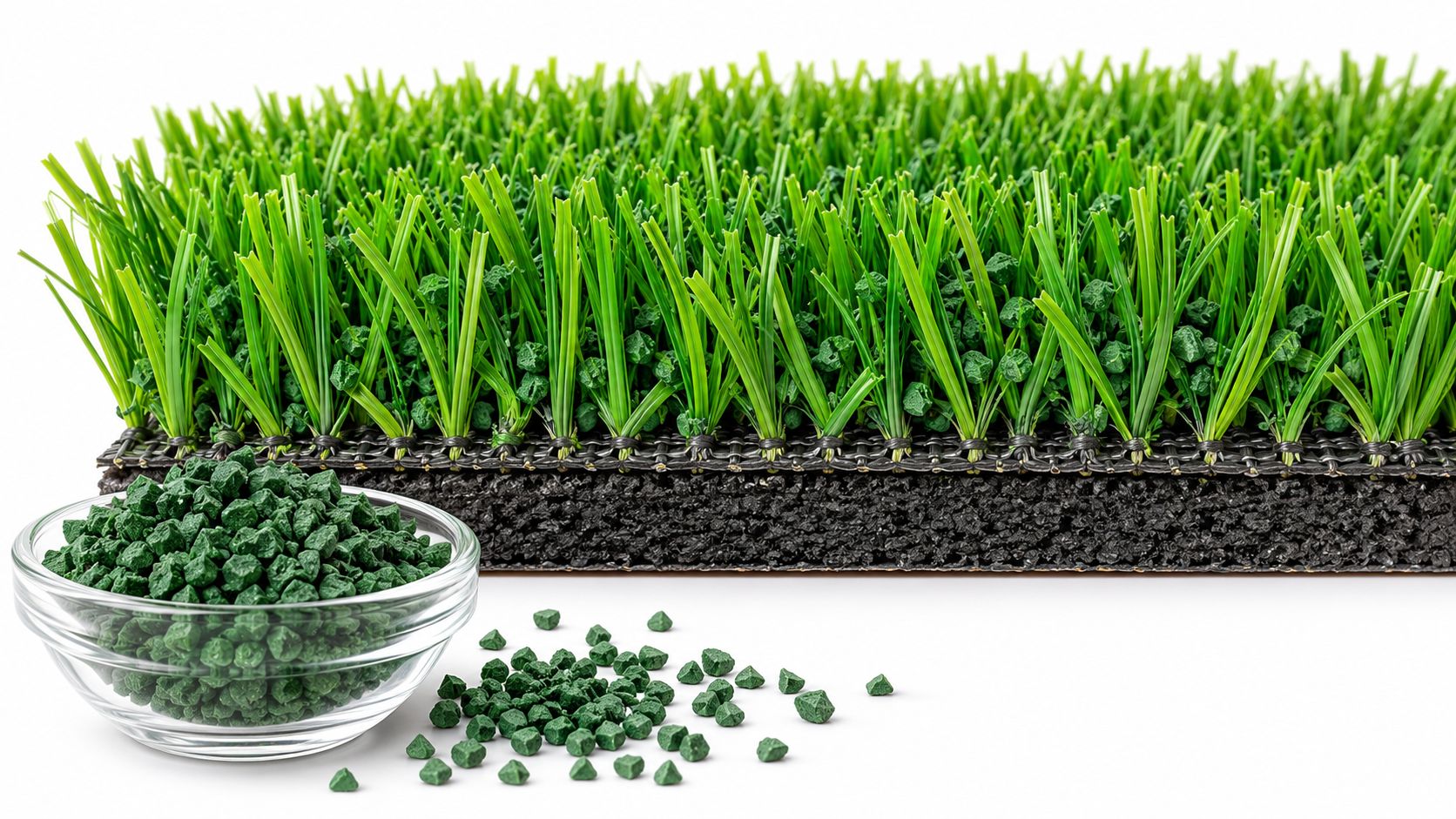
PFAS-free infill doesn't establish that an entire artificial lawn is PFAS-free. When someone asks whether the infill is safe, the answer needs to distinguish the loose granules from the blades and backing.
This close-up shows the physical separation between the turf construction and loose infill.
California's 2025 artificial-turf field and exposure characterization report reported no PFAS detected in the tested crumb-rubber infill, while public findings identified turf blades as a suspected source. That is a finding about tested materials, not a blanket certification for every crumb-rubber product or complete turf system.
PFAS is the name for a broad group of fluorinated chemicals. A meaningful test document should identify the material tested, the substances included, the method, and the reporting limits. Not detected means the test didn't detect the targeted substances above its reporting limits, not that every possible chemical was absent.
Evaluate the complete material pathway
Microplastics are small plastic particles, which can include fragments from synthetic fibers and polymer infill. Don't assume that letting water pass through the lawn also prevents particles from leaving it.
Plan containment and disposal before installation:
- Request component-level documentation: Obtain separate information for blades, backing, and infill rather than relying on an undifferentiated safety claim.
- Specify containment: Include secure edges and suitable filtration where the drainage design requires it.
- Inspect escape routes: Check boundaries and drainage collection points for displaced granules after storms.
- Collect loose material: Don't wash or blow it into soil, gutters, or drains.
- Confirm removal options: Identify who can separate, transport, accept, and process the materials when the installation is replaced.
Keep these material distinctions in mind when reviewing turf explanations and demonstrations.
Get a usable end-of-life answer
Recyclable isn't the same as having an available recycling service. Ask which facility accepts the actual combination of turf, backing, and infill, whether separation is required, and who pays for transport.
If recycling isn't available, obtain a lawful disposal plan rather than assuming one will appear later. Save the product identities with the installation record so a future removal contractor knows what must be handled.
Choose the Right Infill for Your Project
Choose artificial turf infill by narrowing the job, not by searching for a universally best material.
- Name the use. Write down whether you're planning a front yard, backyard, dog run, playground, sports surface, putting green, or commercial area. Separate zones if their demands differ.
- Identify the demanding conditions. Note concentrated foot traffic, pet waste, shade, moisture, ball response, and any need for cushioning. Include who will perform maintenance.
- Shortlist compatible materials. Compare only infills approved for the turf and intended application. Evaluate the maintenance commitment alongside the desired feel.
- Confirm the specification. Obtain the loading rate, installation checks, and material documentation before approving the final scope.
What to settle before buying
Your decision should answer these questions:
- Purpose: What must the finished surface let people or animals do?
- Exposure: How much traffic, waste, and moisture will it receive?
- Documentation: What can the supplier substantiate about the blades, backing, and infill?
Our project estimate form asks where the turf will be installed, including front yard, back yard, sports turf, commercial, putting green, or another location. That starting point helps define the job, but your notes about daily use make the request more informative.
Measure the intended area and mark gates, drains, downspouts, and access restrictions before requesting an estimate. Then ask for the infill type and loading rate in writing before the quote is final, so you're comparing complete systems rather than green surfaces alone.
Waterloo Turf Indianapolis designs and installs synthetic grass systems for yards, pet areas, putting greens, play spaces, and commercial properties, with base preparation, drainage planning, infill application, and final power brushing. Visit Waterloo Turf Indianapolis to request a project estimate, and bring your area measurements and intended-use notes so infill can be considered as part of the complete installation.