Artificial Grass for Dogs Cost: What You Really Pay
Artificial grass for dogs cost runs about $10-$20 per square foot installed. See prices by yard size, pet-ready upgrades and quote items to check.
Professionally installed artificial grass for dogs costs about $10 to $20 per square foot across the U.S., which puts a typical 500 square foot residential pet area at roughly $5,000 to $10,000. A 200 square foot dog run lands nearer $2,000 to $4,000, and a full 1,000 square foot dog-friendly yard runs about $12,000 to $20,000.
Those numbers are real, and they're also the least interesting part of the decision. A 2016 study of 300 dogs at three Northern California dog parks detected at least one enteropathogen in 38% of sampled dogs and found no statistically significant difference between the artificial-turf park and the natural-grass parks, as a review of artificial turf for pets reports. The surface itself doesn't disinfect anything. What decides whether a yard stays usable or gets ripped out two summers later is the base and the drainage underneath it.
So the useful artificial grass for dogs cost comparison isn't the price of a roll of turf. It's the price of turf plus the compacted base, the drainage path, the infill and the cleaning routine that keeps the system working. Two quotes at the same rate per square foot can differ by thousands of dollars in what sits below the surface, and only one of them comes with a yard you'll still want in year eight.
Artificial Grass for Dogs Cost by Yard Size
Professionally installed artificial grass for dogs commonly falls in a broad U.S. range of about $10 to $20 per square foot, according to Mighty Grass's pet turf cost breakdown. Premium pet systems sit above that, with permeable backing, enhanced drainage, antimicrobial or odor-control infill and additional preparation pushing some installations to $15 to $22 per square foot.
The table converts those rates into the sizes homeowners build. Measure the area the dog uses, not the whole lot, then find the closest row.
| Yard size | Price per sq ft | Estimated installed cost | Other benchmark |
|---|---|---|---|
| 200 sq ft dog run | $10-$20 | $2,000-$4,000 | At the premium $15-$22 rate, $3,000-$4,400 |
| 500 sq ft residential pet area | $10-$20 | $5,000-$10,000 | Indianapolis example at $12-$18 per sq ft gives $6,000-$9,000 before site extras |
| 800 sq ft pet-ready dog yard | $15-$19 | $12,000-$15,200 | The same 800 sq ft at the $10-$20 national range is $8,000-$16,000 |
| 1,000 sq ft dog-friendly yard | $12-$20 | $12,000-$20,000 | Site Prep: $14,000-$16,000 for most projects; Modern Yard Landscapes: about $15,200 |
Why two yards of the same size price differently
Read every row as a planning estimate rather than a quote. Excavation, site access, local labor and drainage move the total, and the same 500 square feet can price differently two streets apart. In Indianapolis, artificial turf typically runs $8 to $15 per square foot installed, and pet systems sit above that typical range because of the drainage and infill work they add to the build.
Do the multiplication for your own yard before you call anyone: usable square footage times the unit range gives you a ceiling to hold against each bid. Then read the line items behind that number. The gap between a $9,000 bid and a $14,000 bid for the same patch of ground is almost never the grass.
How the Installed Price Breaks Down
Every credible quote starts from the same arithmetic: usable area × installed unit price, then adds or subtracts for the work the site demands. The SimplyWise artificial turf cost guide is blunt about the benchmark range being a planning estimate rather than a guaranteed quote, because excavation, access, local labor, drainage and turf specification each move the total.
What the invoice covers is mostly work you'll never see once the turf is down.
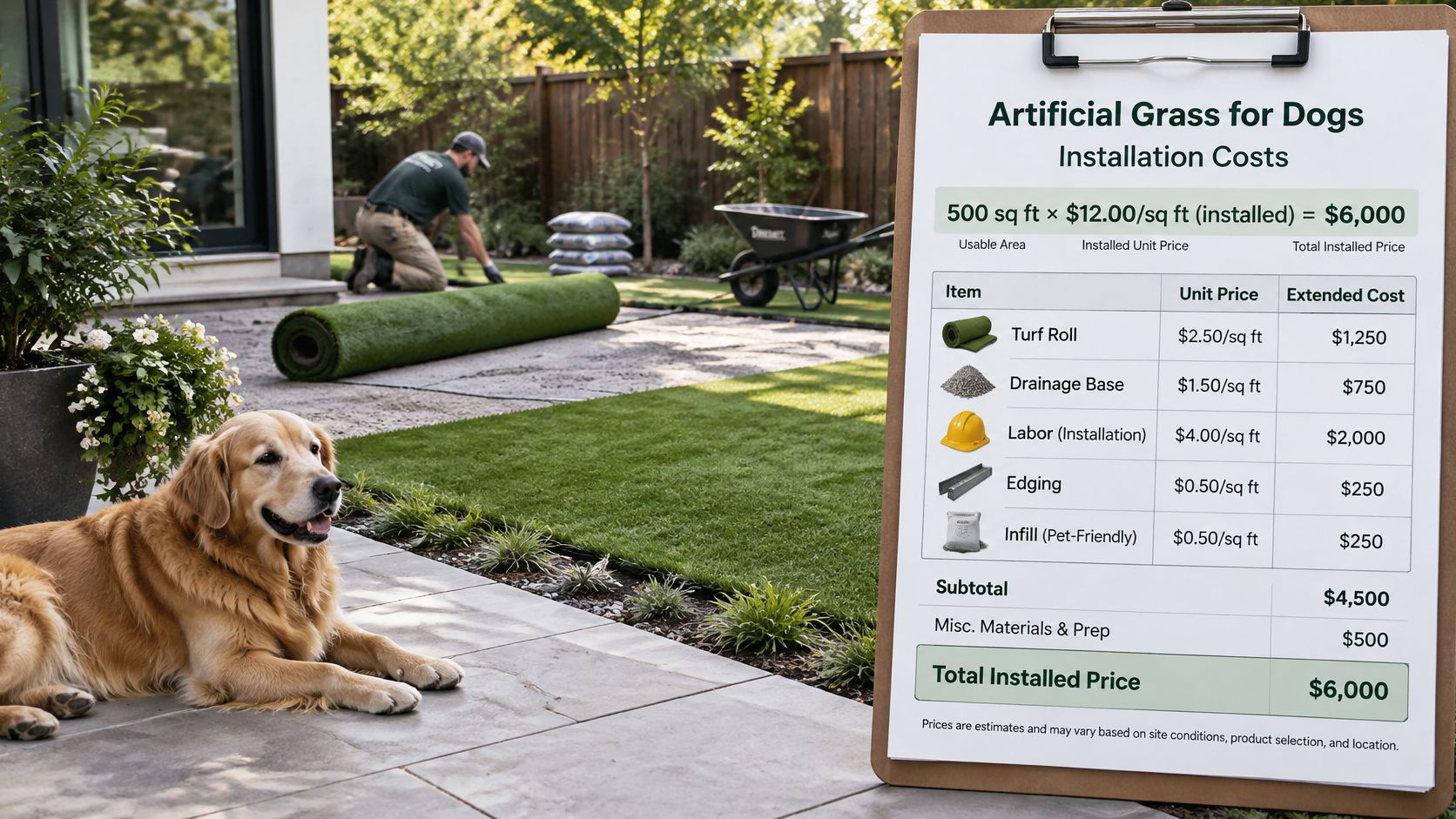
Here are the seven items behind a dog turf number, in the order they hit the site.
- Demolition and removal. Existing sod, weeds and edging come out first, and the tonnage has to go somewhere.
- Soil excavation and haul-away. A few inches of soil typically leave the yard so the base can sit at the right grade, and disposal is a real cost line.
- Compacted base aggregate. Crushed stone built up in lifts and compacted, with open-graded drain rock where water needs to move.
- Turf product and backing. The surface you see, plus the backing that decides how fast liquid passes through.
- Infill. Sand, coated sand or a zeolite blend, including antimicrobial or odor-control products where the spec calls for them.
- Edging, seams and borders. Steel or aluminum edge restraint, glued and nailed seams, and clean transitions at patios and walkways.
- Drainage work and grading. A drain outlet, slope correction, or a tie-in to an existing low point in the yard.
A worked example on 500 square feet
Take a 500-square-foot Indianapolis dog area at $12 to $18 per square foot. That implies roughly $6,000 to $9,000 before site-specific extras. If the soil is heavy clay and holds water, deeper excavation and more aggregate push the figure up. If a drain has to be tied to a lower outlet, that's another line. A single lump sum hides both, which is why an itemized estimate is the only kind you can compare.
The base is where under-specification hides, so it's worth understanding how a proper artificial grass base layer is built before you sit down with a bid sheet.
Rule of thumb: if a line item isn't written on the estimate, it isn't in the price. Ask which of the seven it excludes.
Write those seven headings on a sheet of paper and fill them in for each bidder. The exercise takes ten minutes per quote and settles more arguments than any conversation about blade quality.
Why Pet-Ready Turf Costs More Per Square Foot
Two quotes for the same dog run can sit thousands of dollars apart, and blade quality rarely explains the gap. The premium lives under the grass, in the drainage and odor-control system, and it shows up plainly in the per-foot number. Indianapolis installations typically run $8 to $15 per square foot installed, and a pet-ready spec pushes to the top of that range or past it once the base, drainage and infill are itemized.
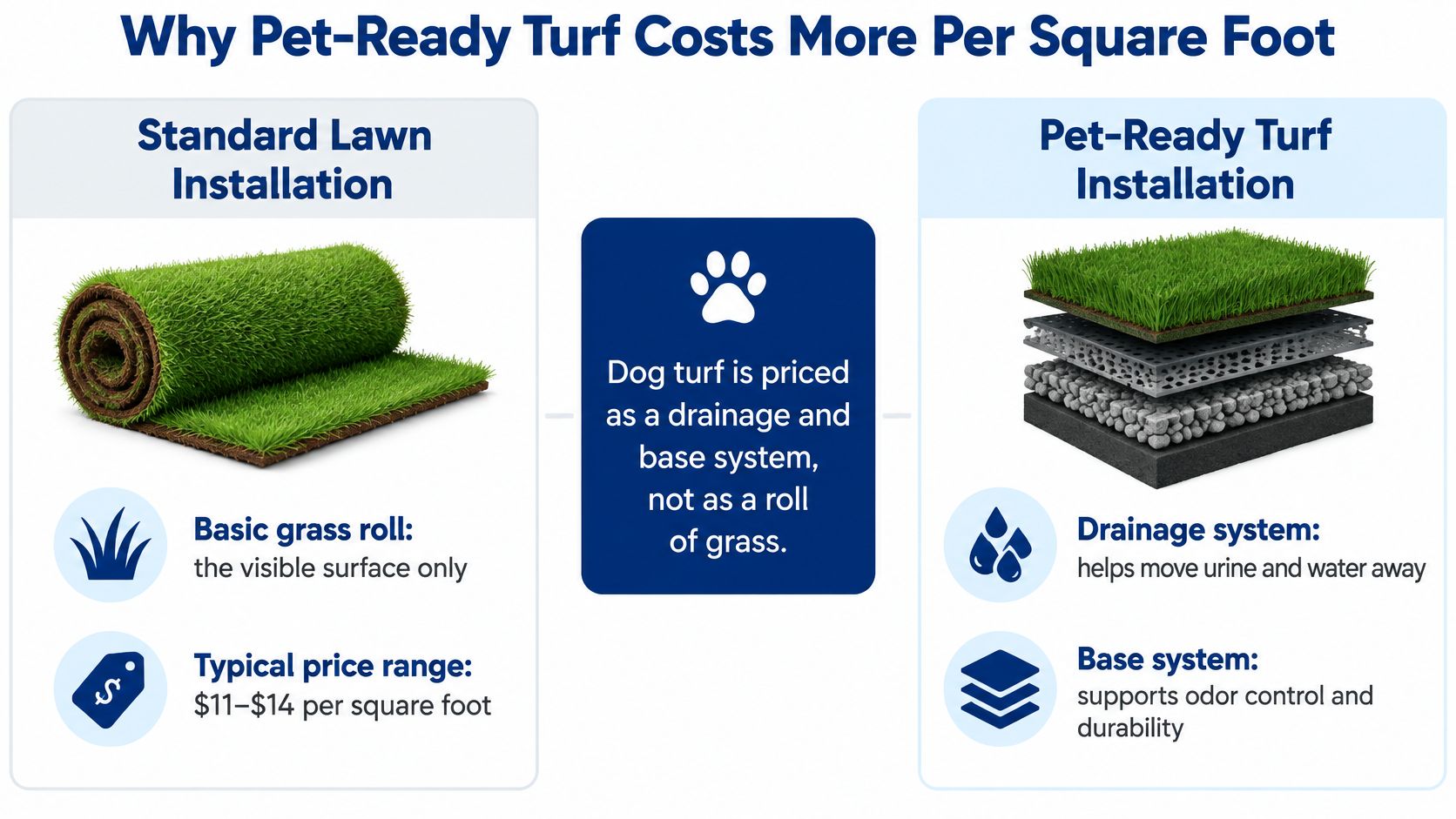
Dog turf is priced as a drainage and base system that happens to wear grass on top. The premium reflects added base depth, specialized infill, stronger seam work and drainage capacity. Each item has a job, and each one shows up as a line on an honest estimate.
What the premium actually buys
A deeper compacted base. Extra lifts of aggregate, with open-graded drain rock selected to move liquid away from the surface instead of holding it. The same dense base is what stops a determined digger from reaching the soil underneath.
A permeable, antimicrobial backing. Standard turf relies on punched holes for drainage. Pet-grade backing drains across its whole surface, so liquid passes straight through, and the antimicrobial treatment reduces odor where it starts.
Pet-friendly infill. A coated or odor-control product that slows the ammonia cycle instead of plain sand or crumb rubber.
Heat-resistant fibers. Pet turf uses heat-resistant materials that keep the surface cooler than traditional synthetic surfaces, so paws meet a tolerable landing on hot afternoons.
Stronger seams and edges. Concentrated traffic finds every weak seam, so the labor goes into gluing, nailing and edge restraint.
| Feature | Standard quality lawn | Pet-ready system | Effect on cost |
|---|---|---|---|
| Installed price | Lower-to-middle of the $8-$15 per sq ft range | Top of the range or above it | The spread widens with yard size |
| Compacted base | Basic compacted base | Deeper base with open-graded drain rock | Extra excavation and aggregate |
| Backing | Perforated backing | Permeable, antimicrobial backing | Faster drainage, less odor, higher material cost |
| Infill | Sand or crumb rubber | Pet-friendly odor-control infill | Higher material cost |
| Seams and edges | Standard fastening | Glued, nailed seams with edge restraint | More labor hours |
When urine and wash water can't leave the backing, they stay near it. Odor, surface movement and repairs all follow from that one failure.
Infill carries much of the odor control, so which artificial turf infill you choose deserves a written line on the estimate before you sign anything. The base and infill work looks like this in practice.
A cheaper quote reaches its number by trimming exactly these items: a shallower base, a perforated backing, plain sand infill. The savings are real on day one and borrowed thereafter, because replacing failed base work is far more disruptive than specifying the right system at the start. That is why the specification sheet outranks the headline price, and why a correctly built system pays back through years of asking for nothing beyond an occasional rinse.
Site Conditions That Move the Final Price
Two yards with identical measurements can hold quotes thousands of dollars apart, and the difference is always the site. Turf project cost depends on the size of the area, access to the yard, drainage needs and existing soil condition. None of that shows up in a per-foot rate pulled off a website.
What changes the number before turf is unrolled
- Existing lawn and soil removal. Old sod, roots and a few inches of soil come out first. Disposal fees scale with volume, and a yard full of gravel or old pavers costs more to strip than a tired lawn.
- Clay and poor drainage. Yards that hold water need deeper excavation and more aggregate, and sometimes a drain tied to a lower point. This is the most common reason a local quote either beats the national benchmark or blows straight past it.
- Slope. A run graded toward the house needs re-grading before turf goes down, or water has nowhere to go but the patio.
- Access. A narrow side gate means wheelbarrows instead of a skid steer. Hours replace equipment, and the labor line grows.
- Distance to disposal. Hauling spoils farther out costs more in truck time, and that line lands in your estimate.
- Edging, borders and transitions. Steel edge, cut borders and clean meets at patios and walkways are detail work priced by the foot.
- A drain outlet and hose access. The rinse routine depends on a hose bib and somewhere for the water to go. If neither exists, it's a scope item, not an afterthought.
Job size cuts both ways. A small run carries fixed setup costs, mobilization and minimum loads spread over very few square feet, so the per-foot rate looks high. A larger yard spreads those costs and usually lowers the rate, even though the total rises.
Three questions before the walk-through
- Where does water go now? Stand in the yard during a heavy rain and watch. If it sheets toward the house or stands for an hour, that's a grading and drainage conversation, not a turf conversation.
- Where can materials land? A driveway wide enough for a truck and a clear path to the work area saves real money.
- Is the dog area on a slope? A gentle crown matters. A run pitched toward a foundation needs correction before anything is installed.
Answer those three before anyone measures, and ask for each site condition to be priced as its own line. You'll see exactly which part of your yard is adding cost.
Ongoing Costs Most Quotes Leave Out
Low maintenance is not the same as maintenance-free, and that distinction is where dog turf budgets break. Tabski's comparison of dog park turf and grass puts ongoing maintenance for a high-use dog-park application at about $500 to $1,200 per month. That's a commercial figure, not a household one, but it shows how far operating costs travel with traffic and cleaning intensity.
A one- or two-dog yard needs far less labor and water than that number implies. A densely used run can need more.
Light, typical and heavy use
Picture a single small dog with a hose bib ten feet from the turf. Daily solids pickup, a weekly rinse, brushing in the traffic lane, and an enzyme treatment on the favorite spot. Fifteen minutes a week, mostly water.
Now a family with two medium dogs and a busy schedule. Solids go daily, or odor starts. The high-traffic lanes get rinsed two or three times a week in summer. Infill gets topped up when it settles below the blade line, and the drainage outlet gets checked each spring.
Heavy use is the dog run that four dogs hit all day. That's weekly rinsing plus enzyme treatment, periodic deep cleaning, and a real willingness to investigate a smell instead of masking it. A base that drains poorly turns a cheap install into an odor remediation project, and no cleaner fixes a base that was built wrong.
What we recommend: pick up solids daily, rinse the urine zones weekly, and treat the favored spots monthly with an enzyme product.
Heat belongs in the same budget. Artificial turf in direct summer sun runs hotter than the lawn it replaced, so a seasonal plan of shade, limited midday access and a quick paw check before play keeps the surface usable. Our pet turf uses a built-in drainage system that lets liquids pass through quickly, and the care routine stays simple: a quick rinse to clear dirt and waste, occasional brushing to keep fibers upright, and no mowing, fertilizing or chemical treatments. Solid waste lifts off just as it does on natural grass.
For a yearly estimate, count the weekly tasks, multiply by your time or a local labor rate, then add water and cleaning products. A simple artificial turf cleaning routine keeps that number small. Skip it and the number grows.
Compare Quotes Before You Commit
Compare bids on installed cost per usable square foot plus the scope of work, never on a headline rate. Two written quotes built from the same specification sheet are comparable. Two quotes built on nothing but a phone estimate are just two numbers.
The low-quote test
If one bid sits far below the rest, check three things: whether base preparation is included, whether infill is specified by product and depth, and whether demolition and disposal are covered. A missing base is the most expensive omission, because correcting it means removing turf that is already installed. Drainage runs a close second. A quote that skips the drainage layer for a dog area is pricing a surface rather than a system, and the odor and sanitation costs that follow land on you, not the installer.
What to get in writing
- Measured square footage, so the unit rate and the total agree.
- Demolition and soil removal, including where the spoils go.
- Disposal costs, listed rather than folded into labor.
- Warranty length and what it covers, in years, on paper.
- The cleaning plan the installer recommends for your dog count.
- The seven line items from the price breakdown, each with a number.
Then compare cost per year of service rather than first price. With proper care, pet turf can maintain its look and function for well over a decade, so divide each quote by the years the surface should last. A cheap system that needs repairs in year three costs more than a properly built one that does not.
Get at least two or three written quotes for the same square footage and the same specification, then read them side by side. That is the step that turns a price into a decision.
Waterloo Turf Indianapolis installs pet turf along with front and back yard turf, putting greens, playground turf, commercial turf and sports turf across the Indianapolis metro. If you are budgeting a dog area, ask for the estimate broken out by the same seven line items used here so you can see exactly what the price includes. Start with a visit to Waterloo Turf Indianapolis and get your square footage measured before you commit.