Polyethylene Artificial Grass: Durability and UV Explained
Polyethylene artificial grass explained: how PE fibers handle wear, UV, heat and drainage, and what each means for yards, pets and putting greens.
An estimated 20,000 synthetic athletic fields are now installed in the United States, according to the New Jersey Department of Environmental Protection's synthetic turf review. That scale makes polyethylene artificial grass an established surface technology, but it doesn't make every product interchangeable.
The useful question isn't whether polyethylene is durable. It's whether the blades, backing, infill, foundation, and maintenance plan can deliver the surface you need. For Indianapolis homeowners and facility operators, that means judging softness alongside wear, drainage alongside base construction, and convenience alongside heat and eventual disposal.
What Polyethylene Turf Is and How It Compares
Polyethylene (PE) is the blade material used in many modern artificial grass products. Its flexible fibers can create a grass-like surface and work with granular infill. The finished turf is a system: fibers are attached to a backing, and the carpet is installed over a foundation.
Artificial turf developed from early surfaces to sand-filled polypropylene systems and then to systems that commonly use PE. That history helps explain why products can differ in feel and construction. The polymer alone, however, does not describe how a complete surface will perform.
Fiber characteristics compared
The table compares general material characteristics. Polyamide is the polymer family commonly called nylon. Individual products can differ by formulation and construction.
| Characteristic | Polyethylene (PE) | Polypropylene (PP) |
|---|---|---|
| Skin feel | Softer, with lower skin abrasion than polyamide | Firmer feel |
| Generation in common use | Common in third-generation systems | Common in second-generation sand-filled systems |
Nylon is useful as a comparison for skin contact, but feel is only one property. A softer fiber does not establish how the installed turf will hold up under repeated use. Likewise, a firmer fiber alone does not determine whether a surface suits a particular activity.
Read specifications as trade-offs
Blade length and flexibility matter in relation to the rest of the system. A longer blade is not automatically an improvement, and a flexible fiber needs suitable support from the backing, infill, and foundation. Specifications are most useful when they describe a product's intended activity and construction.
For Waterloo Turf Indianapolis, turf features polyethylene blades, a high-quality backing system, UV resistance, and durable infill materials. Those components work together, so a fiber description by itself cannot establish the performance of the complete installation.
Buying principle: A polyethylene blade identifies a material, not the performance of the installed system.
How Polyethylene Fibers Handle Wear and UV Exposure
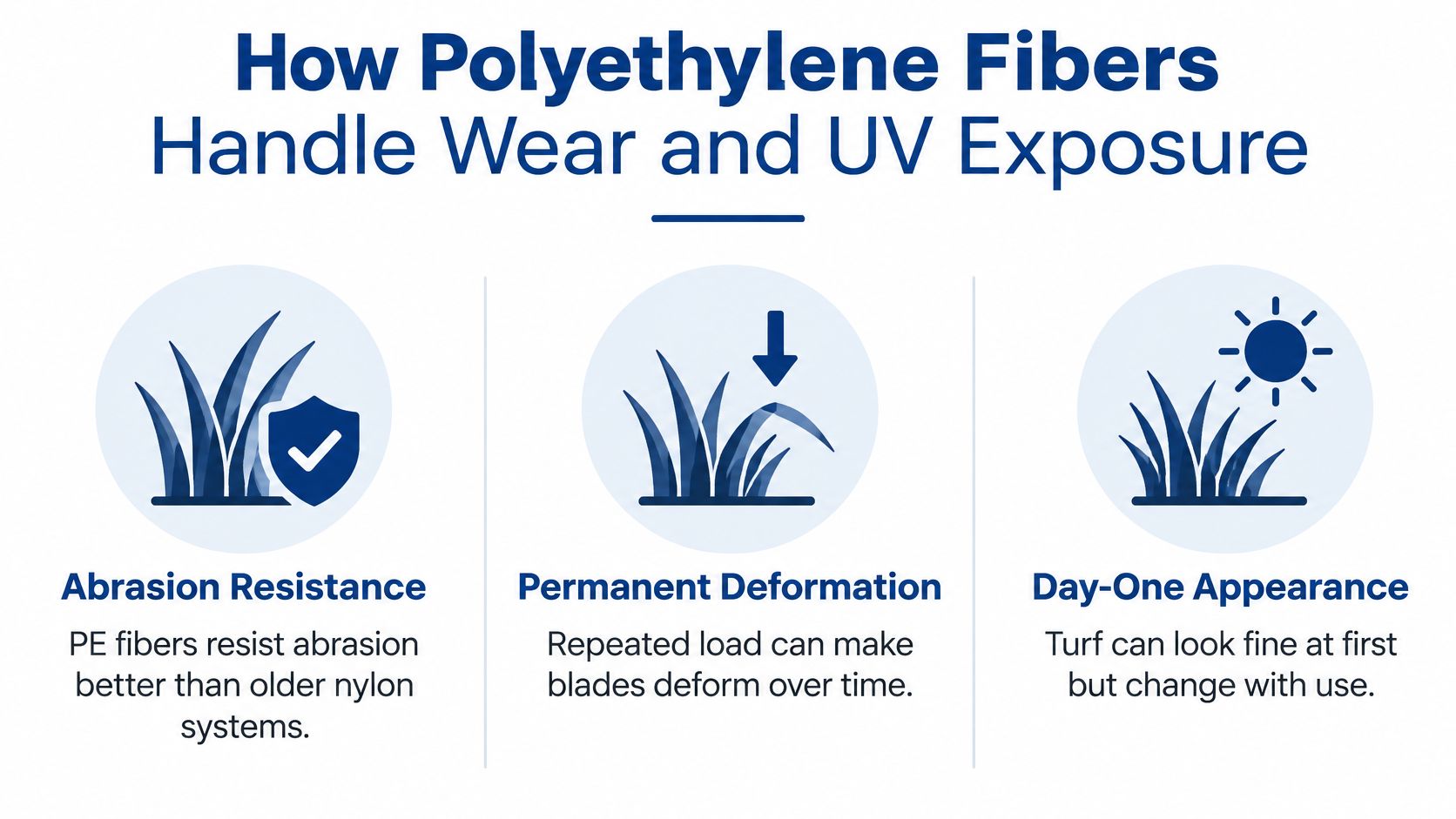
PE can be gentler against skin than older nylon surfaces, but lower skin abrasion isn't proof of greater resistance to fiber wear. A comparative study of artificial turf fibers describes the favorable skin-contact properties of PE monofilaments alongside their tendency to deform permanently under sustained mechanical stress. That distinction matters when evaluating durability claims.
A blade can bend comfortably beneath a foot and still struggle to recover after repeated loading. A dog following the same fence line, athletes pivoting near a goal, or visitors crossing a narrow entrance can concentrate use in a small area. A sample viewed on a showroom table won't reveal that wear pattern.
The graphic highlights the difference between initial appearance, contact characteristics, and performance under load. Its abrasion comparison should be read as a skin-contact distinction, not a blanket claim that PE outlasts nylon.
What sunlight changes inside a blade
Think of ultraviolet radiation as a slow cutting tool acting on the polymer chains. Exposure can break molecular bonds and reduce strength, elongation, and stiffness. Manufacturers incorporate UV-stabilizing additives to slow that degradation, not to make polyethylene immune to sunlight.
Color retention alone isn't enough evidence of structural condition. A buyer needs weathering documentation that addresses mechanical properties, rather than relying only on a photograph of a green sample.
Repeated loading, insufficient maintenance, and changing temperatures add separate stresses. They're worth evaluating together because an exposed, heavily used entrance has a different service environment from a decorative lawn.
Match evidence to the actual use
Ask for documentation that answers practical questions:
- Wear testing: What loading or abrasion procedure was used, and what changed after testing?
- Weathering testing: Which properties were measured before and after exposure?
- Construction details: What fiber shape, formulation, and infill support were included in the tested system?
- Acceptance criteria: What result counts as satisfactory, rather than confirming that a test occurred?
A warranty describes contractual coverage. It doesn't replace those results, and it may distinguish between fading, fiber loss, and ordinary flattening.
For a lightly used front lawn, the required wear performance may be modest. A dog run, commercial walkway, or sports area needs evidence suited to repeated concentrated use. Don't assign a reliable lifespan in years from the PE label alone. Match the construction to the use, then verify the service-life claim against relevant testing and maintenance requirements.
How Polyethylene Feels Underfoot and Drains Water
PE blades offer a flexible feel closer to the give of grass than the rigid appearance many buyers associate with older artificial surfaces. But what you feel underfoot isn't just the blade bending. You're also feeling the resistance of the infill, any cushioning layer, and the foundation beneath the carpet.
The cutaway illustrates why comfort and water movement need a layered explanation.
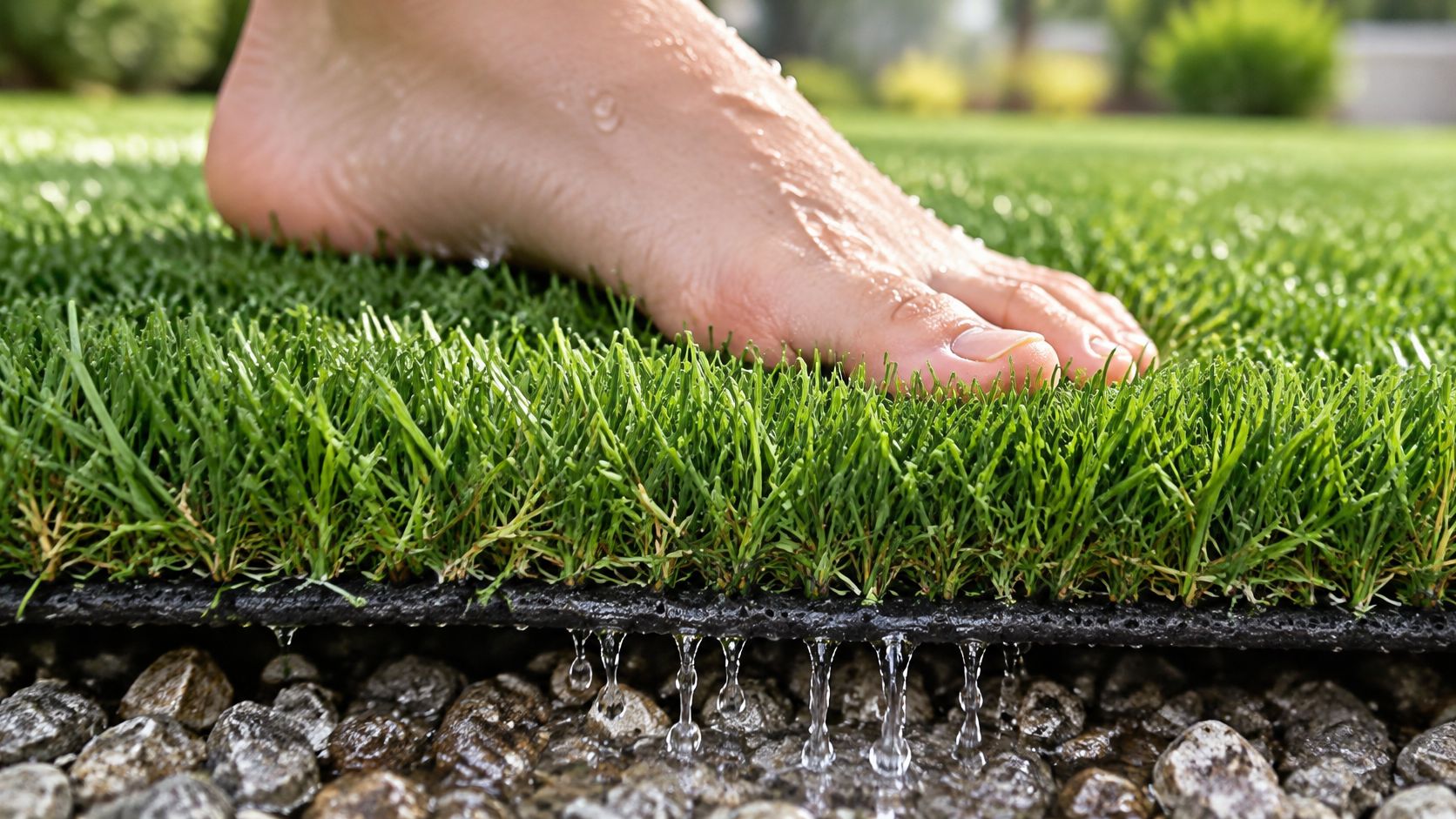
Build the assembly from the ground upward
A technical review of synthetic turf systems describes contemporary PE field fibers approximately 35 to 70 mm long, with space for infill that supports the blades, controls hardness, and distributes athlete loads. That field-system range isn't a recommendation for every backyard application, especially a putting green.
Think of the assembly as a layered cake, except water must pass through rather than remain trapped between layers:
- Foundation and sub-base: Provide stable support and a route for water to leave.
- Drainage and cushioning layers: Manage water movement and, where specified, impact performance.
- Backing: Holds the tufted fibers while allowing the intended drainage pathway.
- Infill and blades: Form the contact surface and influence support, feel, and loading.
Every layer must be compatible with the layers above and below it. A permeable carpet can't compensate for an underlying layer that blocks water.
Separate carpet permeability from installed drainage
The New Jersey environmental review describes a benchmark drainage criterion of approximately 10 inches per hour under ASTM F1551 or EN 12616 methods. Treat that as a specification benchmark, not a promise that a finished yard will drain at that rate under every condition.
Ask what was tested: the carpet alone, a laboratory assembly, or the completed installation. Also identify where water goes after passing through the backing. A drainage claim without an outlet or receiving-base design leaves the most important installation question unanswered.
For another view of turf installation, use the video alongside the written layer specification.
PE laid directly over poorly compacted soil can still wrinkle, pond, or lose uniformity. The fibers may remain intact while the surface becomes unsatisfactory because the foundation has moved.
Polyethylene isn't a complete quality specification. Require pile dimensions, backing permeability, foundation preparation, and a drainage route in the same proposal.
Why Polyethylene Turf Runs Hot and How to Plan Around It
Some third-generation synthetic turf systems have been measured near 93°C (199°F), an extreme observation rather than a forecast for every Indianapolis yard. The synthetic-turf temperature discussion in a public-health presentation to the New Jersey Pinelands Commission also notes that brief irrigation may cool a surface for only about 20 minutes.
Those findings challenge the assumption that a soft surface is necessarily comfortable in direct sun. PE blades themselves contribute substantially to surface heating. Premium infill doesn't stop them from being thermoplastic.
The graphic summarizes the planning issue without establishing a universal safe-use temperature.
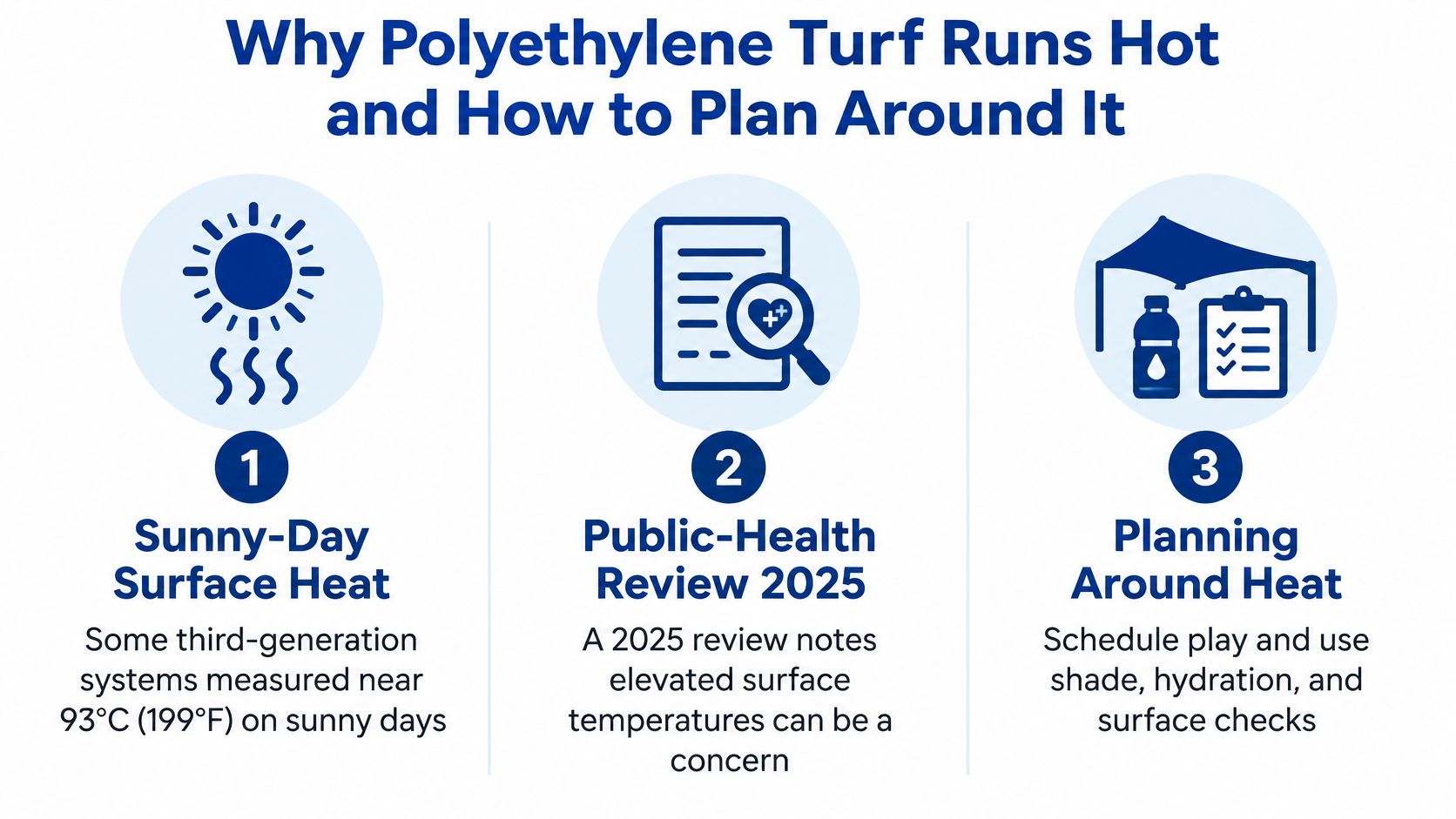
Use a surface-specific heat protocol
Sun exposure, air temperature, color, pile construction, infill, shade, and watering all affect temperature. Changing an infill may reduce peak heating, but it doesn't eliminate natural grass's thermal advantage in direct sun.
- Measure before use. Use an infrared surface thermometer on representative sunny and shaded patches before children, pets, or athletes enter. Follow the instrument's measurement instructions.
- Add shade where feasible. Evaluate a canopy or planting location against the actual afternoon sun path, not just the appearance of the yard.
- Change activity timing. Move play, training, and dog exercise away from peak sun when the surface is hot.
- Treat watering as temporary. If you wet the turf, recheck it before use and during continued activity. A recently rinsed surface isn't a lasting cooling guarantee.
- Separate user groups. Bare feet, paws, and clothed athletes have different contact patterns. Don't apply a sports-use decision automatically to toddlers or pets.
A cooling feature is a material attribute. Safe access still requires a decision about the conditions on the surface.
A household needs a practical alternative when the turf is too hot, such as a shaded play area or another exercise route. A facility needs someone responsible for checking conditions and restricting access when appropriate.
On hot Indianapolis summer days, the useful purchase question is therefore not whether a product has a cooling label. It's how the property will remain usable when direct sun makes the turf unsuitable for the intended activity.
Where Polyethylene Turf Works Best and What to Check
The best use for polyethylene artificial grass is the one its complete specification supports. A front lawn, dog run, and practice green may share a fiber material while needing different surface textures, foundations, and upkeep.
For residential lawns, start with appearance and feel, then inspect the proposal for foundation stability. For pet areas, reverse that order: prioritize liquid movement and cleaning access before choosing the shade of green.
Polyethylene turf spec by use
| Use | Key spec to check | Base or infill priority | Main risk |
|---|---|---|---|
| Residential front or back lawn | Pile height and documented UV performance | Compacted base and planned drainage slope | Wrinkling on a poor base |
| Pet area | Perforated or rapid-drain backing | Compatible odor-control infill and rinse routine | Odor and urine buildup without drainage |
| Backyard putting green | Pile density and uniform texture | Smooth base with built-in drainage | Ponding and uneven roll |
| Playground or play space | Tested impact-protection assembly | Compatible shock-absorbing underlay and base | Inadequate impact protection and high temperature in sun |
| Commercial or sports high-traffic zone | Documented wear-resistant construction | Infill support and planned replenishment | Matting in concentrated traffic zones |
An antimicrobial infill claim shouldn't substitute for drainage or cleaning. Ask what the treatment addresses, whether it is compatible with the turf, and what maintenance it requires. Don't assume an antimicrobial label proves control of every source of pet odor.
Different activities need different acceptance checks
A putting green requires a trial focused on ball response, not barefoot softness. Evaluate the proposed texture and contours according to the practice you want, and use the putting green installation guide to address questions about base smoothness, drainage, and finished roll. A turf sample alone cannot show those results.
For a playground, identify the intended equipment and require impact-performance documentation for the proposed assembly. A soft-feeling PE blade isn't evidence of adequate fall protection. Temperature management also belongs in the operating plan, not just the product selection.
Commercial and sports zones require an honest map of activity. Mark entrances, goal areas, turning points, and narrow routes where users will concentrate. Evaluate those locations separately rather than averaging their demand across the entire site.
Heavy use calls for a wear-qualified construction and a planned maintenance routine. Choosing the same light-use specification everywhere may simplify purchasing, but it ignores the locations most likely to determine when the owner becomes dissatisfied.
Maintenance Each Use Requires Over Time
PE turf doesn't need mowing or fertilizer to keep growing because it isn't living grass. It still needs cleaning and surface management, and water may be required for sanitation or temporary cooling even though irrigation isn't needed for plant growth.
Use the following schedule as a condition-based reference, not a universal calendar. Product instructions, use intensity, and the actual condition of the surface should determine when work happens.
Typical maintenance schedule by use
| Task | Residential lawn | Pet area | Putting green | High-traffic commercial |
|---|---|---|---|---|
| Remove debris | After leaf fall, storms, or visible accumulation | Remove solid waste promptly; clear other debris as it appears | Before play when debris affects roll | Include in opening and closing checks |
| Rinse | When dirt or spills require cleaning | After soiling and when urine or dirt accumulates | When contamination affects the surface | After spills or visible contamination |
| Brush fibers upright | When traffic leaves blades leaning | Where repeated routes flatten fibers | Groom to the green manufacturer's instructions | When traffic creates uneven fiber posture |
| Top up infill | After checking depth against specifications | Check heavily used routes and cleaning areas | Follow the specified green system | Inspect worn zones and replenish to specification |
| Inspect seams and edges | During cleaning and after disturbance | Check digging and turning areas | Check during grooming | Include in routine site inspections |
Brushing helps reposition blades that are leaning, but it won't necessarily reverse permanent deformation. Use a turf-compatible synthetic-bristle brush and avoid aggressive tools that could damage fibers or seams. For a putting green, follow the prescribed grooming direction rather than treating it like long-pile lawn turf.
The graphic summarizes the basic tasks, but task timing should follow surface conditions.
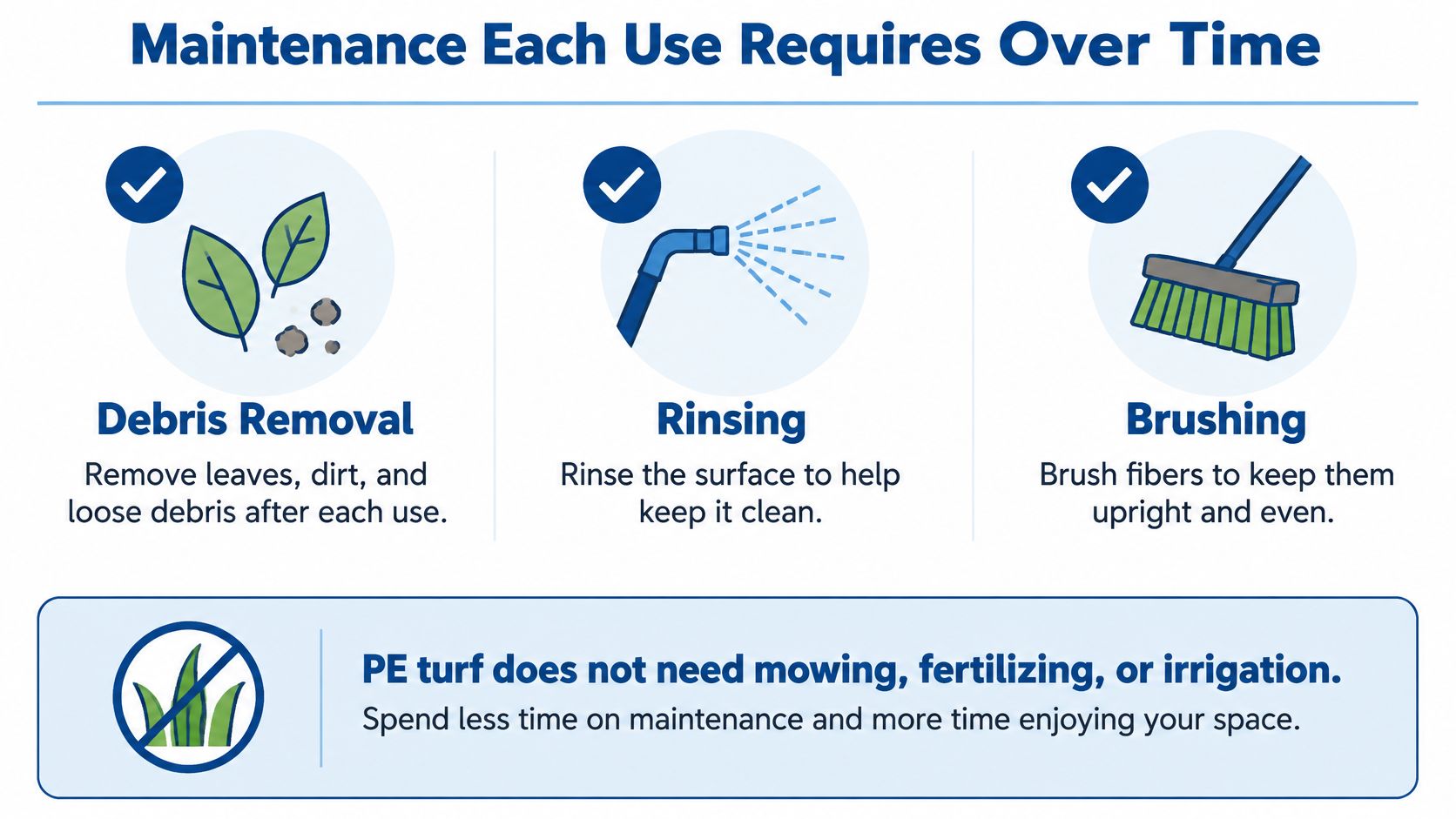
Act on early warning signs
- Flattened patches: Brush gently, check infill support, and assess whether traffic needs redirecting.
- Exposed backing: Inspect for displaced infill or fiber loss before adding material.
- Lifting seams: Restrict access to the affected area and arrange a repair rather than concealing it.
- Persistent odor: Remove contamination, use a compatible cleaning method, and investigate drainage.
- Pooling after rain: Check for blocked drainage or base movement instead of repeatedly brushing the surface.
Infill maintenance requires the correct material, not more loose granules. The artificial turf infill guide can help distinguish its support and application roles.
Keep a simple record of inspections, cleaning, repairs, and infill additions. That gives the owner a basis for spotting changes and discussing warranty coverage without relying on memory.
What Happens to Polyethylene Turf at End of Life
Polyethylene turf remains plastic after installation, and some of that plastic can leave the site before removal. A National Collaborating Centre for Environmental Health review cites the European Chemicals Agency estimate of approximately 16,000 tonnes of artificial-turf microplastics released annually in EU countries; it also describes a mechanical recycling process through which only about 75% of the material is currently recyclable.
The European release estimate isn't a measurement of Indianapolis yards. It establishes a reason to take containment seriously, while the process-specific recycling figure shows why a recyclable label isn't enough to establish a complete disposal pathway.
Prevent loss while the turf is in use
Keep collected debris and loose fibers out of stormwater drains. Collect sweepings for appropriate disposal rather than washing them off the property. Ask the installer to show how edges, drainage outlets, and maintenance access will help contain loose material.
Product disclosure matters here. The blades, backing, and infill may need different handling, so a record stating only artificial grass provides little help to a future removal contractor.
Environmental test: A credible end-of-life plan names an accepting facility and its requirements, not just a material that could theoretically be recycled.
Choosing PE blades doesn't determine the environmental profile of the infill. Avoiding rubber infill may avoid concerns specific to that material, but it doesn't make the remaining plastic assembly circular or environmentally benign.
Follow the material through removal and sorting
Removal should include a containment plan. Establish who collects loose infill and fibers, protects nearby drains, and transports the removed carpet.
Sorting determines what a processor can accept. Confirm whether the carpet must be separated from infill and whether the backing composition is compatible with the proposed process. A facility's acceptance criteria matter more than a general statement about polymer recyclability.
Recycling or disposal needs documentation. Request the destination, acceptance confirmation, and removal records. If part of the assembly can't be recycled, identify its disposal route rather than allowing an overall recycling claim to obscure the remainder.
Ask about take-back arrangements before signing the installation contract. A written removal pathway won't eliminate environmental impacts, but it gives the owner something actionable when replacement becomes necessary.
Confirm the Specs Before You Choose Polyethylene Turf
Choose polyethylene turf on the strength of a written assembly specification, not a fiber label or a sample's initial appearance. Put competing proposals side by side and identify omissions before comparing the final price.
A useful proposal should let you understand what will be installed, why it suits the activity, and what evidence supports the performance claims. It should also separate product characteristics from installation responsibilities.
Use a written decision checklist
- Confirm the fiber and pile. Obtain the blade polymer, pile length in millimetres, and the product identifier so the delivered material can be checked against the quote.
- Request drainage evidence. Identify the tested assembly, test method, foundation design, and route by which water leaves the site.
- Review UV and wear results. Ask what was measured and how the results relate to the intended use. Don't accept a warranty duration as a substitute.
- Check base preparation. Require the proposed material, compaction approach, grading, seam treatment, and edge fastening. Resolve exclusions before work begins.
- Record material and removal disclosures. Include backing, infill, available PFAS testing, claimed service life, maintenance obligations, and the expected removal pathway.
Waterloo Turf Indianapolis is one local option to include in that comparison. Our turf features polyethylene blades, a high-quality backing system, UV resistance, and durable infill materials. Those attributes belong in the same written review as the site-specific foundation and drainage plan, rather than replacing it.
Make the decision on documented fit
Keep routine care requirements with the product documentation so whoever maintains the property can follow them. Clarify which cleaning products and grooming tools are compatible with the selected system.
Before signing, resolve every material difference between proposals. The stronger choice is the assembly with evidence suited to your property and use, not the quote with the most durability adjectives.
Waterloo Turf Indianapolis offers synthetic grass design and installation for residential lawns, pet areas, putting greens, play spaces, and commercial or sports properties. Visit Waterloo Turf Indianapolis to discuss a polyethylene turf system and request written specifications covering the blades, backing, infill, base preparation, and drainage for your site.