Indoor Putting Green Turf: How It Rolls and Lasts
Learn how indoor putting green turf rolls true, which roll speed to target, how to install it and what durability and air quality questions to ask.
February in central Indiana leaves a golfer two options. You can putt at a coffee mug on the living-room carpet, or you can quit until the thaw. Both are bad deals, because the stroke you spent all last summer grooving starts to feel like a rumor, and by the time the first decent day arrives you're weeks behind.
An indoor green fixes that, but only if the surface behaves like a surface instead of a rug. Buyers often pick one the way they'd buy carpet. They look at the color, run a hand over the pile, and take a salesperson's word that it rolls at tour speed. That's how you end up with a mat that's quick on Tuesday, slow after a humid week, and breaking left for no reason anyone can name.
What separates a green that sharpens your stroke from an expensive mat comes down to two habits: measuring roll speed in both directions before you trust it, and getting a written answer about what's in the material before it goes into a room your kids and dog share.
Why Indoor Putting Practice Needs Its Own Surface
A week of rain costs more than a week of tee times. It costs the feel of a stroke built entirely on repetition, and feel is the first thing to leave.
Putting is worth protecting. Research on PGA Tour play archived by MIT's DSpace repository estimates that putting accounts for approximately 40% of all strokes taken, which makes an indoor green a controlled practice environment for one of the highest-volume skills in golf rather than a basement novelty. The usual scorecard measure, putts per round, hides how hard your putts were, because a 6-foot putt and a 30-foot putt are not the same task. That gap is exactly why the strokes-gained and putts-gained methods exist: they compare your result against the expected number of putts from the starting distance, using large professional datasets, including every recorded stroke in ShotLink data, and they model both the chance of holing the putt and the expected result after a miss. The habit isn't new either, since golfers in cold climates were rolling putts on carpets and mechanical putting games in the late nineteenth century, as the Indoor Golf Alliance's history of indoor golf records.
That logic drives a simple design rule. An indoor green should offer several distances, realistic breaks and repeatable speed, not one flat strip for six-footers. Multiple cup locations and some contour let you work on start line, distance control and breaking putts under identical conditions every session, because indoor turf isn't affected by rain, temperature, mowing or seasonal dormancy.
Track three numbers from your first session and keep them in a note on your phone.
- Make percentage from a set distance. Ten putts from 8 feet, counted, once a week.
- Finishing distance on misses. The average leave on a miss tells you more than makes do early on.
- Putts per practice round. Eighteen holes around your cup positions, scored like a round.
The honest measure: a putt that misses and stops 18 inches away beats one that drops after you aimed at a lucky line.
Everything after this comes down to six decisions: the roll speed you're targeting and how you'll measure it, what builds that roll underfoot, the layout you choose before ordering, the material questions for an enclosed room, the installation sequence, and the care routine that keeps the number steady.
Roll Speed Targets You Can Measure at Home
Roll speed is a distance, not a texture. That's the most useful thing to understand about indoor putting green turf: you can put a number on it before you buy and check the same number five years later.
The instrument is the USGA Stimpmeter, a 36-inch ramp with a 145-degree V-groove and calibrated release notches. It launches the ball at a repeatable speed, so readings taken weeks apart by two different people mean the same thing. The Stimpmeter guide from Pitchcare classifies roughly 4.5 feet as slow, 6.5 feet as medium and 8.5 feet as fast, and makes the point that a residential indoor green should be tuned to the golfer's practice objectives rather than a single universal target.
| Practice goal | Stimpmeter reference | What it trains | How to check it |
|---|---|---|---|
| Short-putt drills | about 4.5 ft (slow) | Start-line and short stroke control | Average both directions at three spots |
| Everyday home practice | about 6.5 ft (medium) | Mixed distances and gentle breaks | Compare center and edge readings |
| Competitive pace simulation | about 8.5 ft (fast) | Lag putting and firm pace control | Use the same ball and release every time |
How to run the test
Set the ball in the notch, release it without pushing, and measure from the base of the ramp to where the ball stops. Then walk to the other side of the same spot and roll in the opposite direction. Average the two readings, and repeat at the center, the perimeter, each cup approach, and the transition where putting turf meets fringe. Use one ball for every reading, because a different ball is a different test.
Rolling in opposing directions cancels small slopes, grain direction, seams and localized soft spots, so the average describes the surface rather than the lucky spot you picked.
Roll one way only and you're measuring your floor, not your green.
When the two directions disagree
A large gap between directions isn't about turf color. It points to a construction or surface-uniformity problem such as uneven subbase compaction, a seam transition, displaced infill or pile orientation. A green that runs 7 feet one way and 5.5 the other is telling you something structural, and no amount of brushing will close that gap.
In a compact room, use the Stimpmeter's half-length notch. It supports a fair comparison as long as you always test the same way, but don't mix half-length and full-length numbers without applying the instrument's prescribed conversion, and confirm that conversion before you compare anything.
Pick a target, then start a log. Two readings in each direction at three spots, written down and dated, kept for the first month. If you're still shortlisting products, this guide to choosing artificial turf for a putting green covers the specifications worth settling before the first roll.
What Makes Turf Roll True Underfoot
A pool table is only as true as the slate beneath the cloth. Run a hand over the felt and you learn nothing about why a ball drifts; the answer sits in a slab of stone you never see. Indoor putting green turf behaves the same way, and the fibre you touch is the last thing that decides the roll.
Layer by layer from the floor up
- The base or subfloor. This sets the flatness of everything above it. A dip you can't feel through a shoe becomes a break you can see when a ball rolls over it.
- The backing. It holds the stitch and gives the surface firmness. A soft backing flexes under the ball and eats speed on firm putts.
- Blade fibre and pile height. These set pace and the amount of skid before the ball starts rolling cleanly.
- Pile direction. Fibres lean. A ball running with the lean travels farther than one running against it, which is why a single green can read quick one way and slow the other.
- Infill. It supports the blades and damps bounce. As it compacts and gathers dust, the surface slows without anyone touching it.
- Seams and edges. A tight seam is invisible to the ball. A gap or a lifted edge deflects it, and the miss gets blamed on your stroke.
Fibre can't rescue a base with a dip in it. That's the point of the whole list. A premium blade over a wavy floor gives you a premium-looking green that breaks wrong.
What the failures look like on the green
Watch for symptoms rather than specifications. A putt that breaks left on a floor you know is level is a low spot in the subfloor. A ball that checks up when you putt the line in reverse is pile direction or a seam. A surface that gets slower across a season, without a spill or a visitor, is dust loading into the infill. A putt that hops as it crosses one line in the room is a lifting seam or a lip at the edge.
Two checks matter most before money changes hands. Ask for a flatness plan for the subfloor, meaning how the installer will find and fill depressions before turf goes down. Then ask for a written statement of pile direction and infill depth, because those two numbers explain half of what your roll test will show later. Both should be verified against the readings you take yourself, not accepted as a description.
Choose Your Indoor Green Layout Before You Order
The comparison above shows the choice that shapes everything else. One green trains a repeatable stroke. The other trains the read.
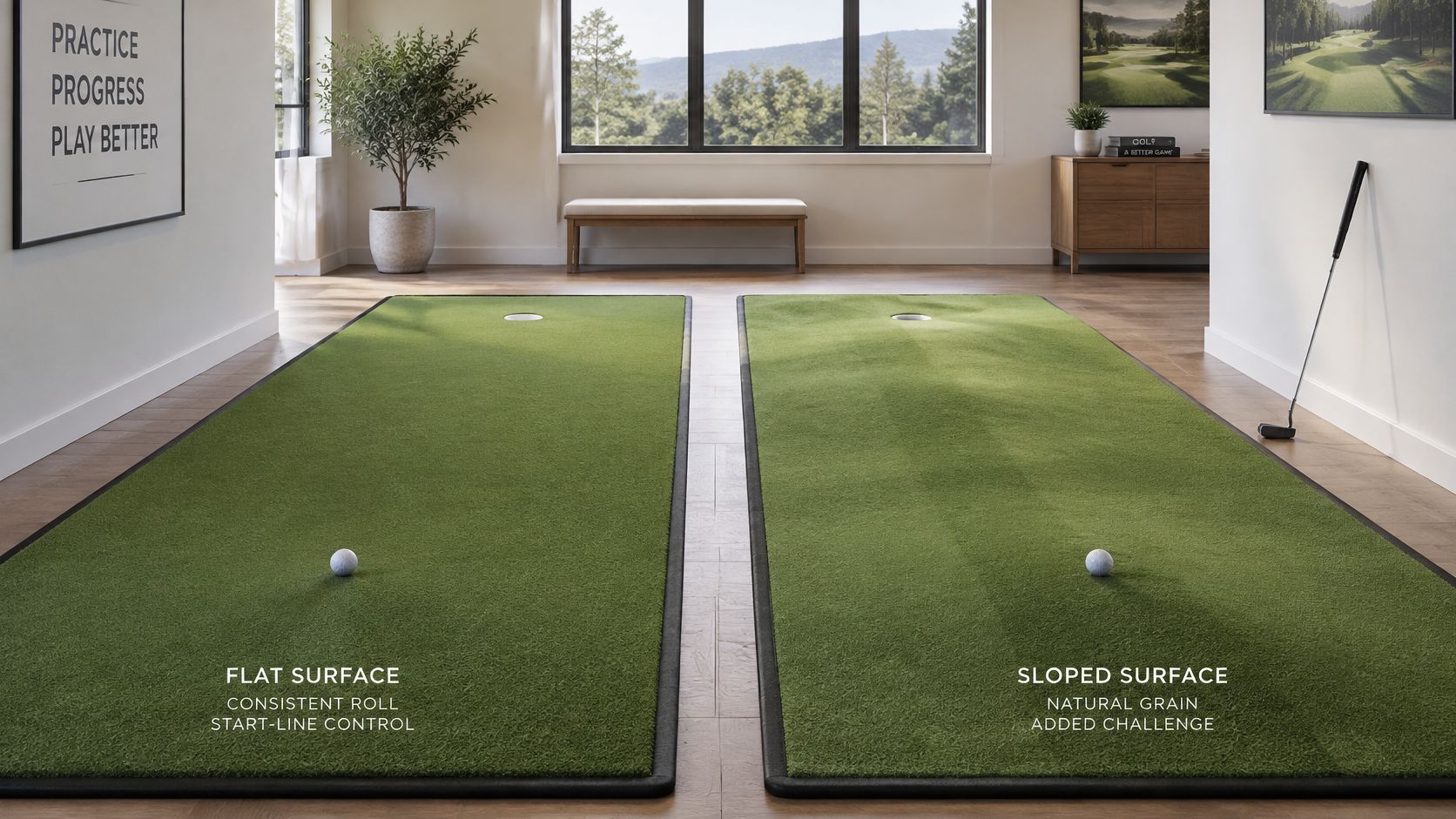
Consistency isn't realism. A perfectly level mat sharpens your start line and leaves lag putting, break reading and uphill or downhill pace under-trained, because a level surface never asks you to judge anything. Reporting on how grain affects a putt describes the outdoor version of that problem: the ball runs faster with the grain and checks up against it, and dust and debris shift roll on their own. Every surface variable covered above moves the number, which is why layout comes after measurement in the order of decisions.
Three honest options exist, and each suits a different practice outcome.
- A portable mat. Start-line repetition in a small space. The speed target is whatever the mat happens to be, slope geometry is flat, there's no transition area, and upkeep is a brush and a roll-up.
- A custom flat installation with fixed cups. Distance control at set yardages, a stable and measurable surface, level to a gentle one-way tilt, no fringe transition, and weekly brushing plus dust removal. This is the workhorse for a spare room.
- A contoured green with transition zones. Mixed practice with uphill, downhill and sidehill putts, plus a fringe strip that changes pace under the ball. Best speed target is medium to fast, with cup positions spread across the slopes.
Whatever you install, measure it the same way every time: identical ball, identical starting line, identical distance, repeated putts. Run the test in both directions along the same line, since a surface that reads quick one way and slow the other fails the consistency check most buyers skip. Marketing labels such as tour speed aren't a specification, and an unmeasured claim about pace is worth as much as an unmeasured claim about horsepower.
Before you order, write down the room length and width, the ceiling height, the practice goal and the target speed, then confirm cup count and layout. Waterloo Turf Indianapolis designs and installs custom putting greens for residential and commercial properties across the Indianapolis metro, built over a compacted base with tight seams and a final power brushing, with cups and contours included in the design.
Air Quality and Material Questions for Enclosed Rooms
Most indoor green guides answer the same short list. Nylon or polyethylene, pile height, how to clean it. Almost none answers the question that matters when the green goes into a basement playroom: what is in the material, and what does the air in that room look like a month later?
The most complete recent review of the evidence is New Jersey's 2025 synthetic turf report, which reports that indoor synthetic turf locations can show higher semi-volatile organic compound levels than outdoor fields, about 1.5 to 10 times higher in the cited comparison, possibly because indoor spaces get less ventilation and less sunlight, rain and weathering. The same review warns that indoor installations may create greater inhalation exposure than outdoor ones because of lower air-exchange rates, and notes that artificial turf can generate microplastics and may contain PFAS in components such as backing or infill.
New Jersey's review also states that the overall research remains limited and inconclusive. That's the right frame. This isn't a hazard rating, and nobody should hand you a safety guarantee. It's a reason to ask specific questions before you sign, especially in a home with children, pets or anyone with respiratory sensitivity.
The questions to send before you order
- Full material declaration, in writing. Ask for blade, backing, adhesive and infill listed separately, because "turf" is not one material.
- A PFAS statement. Ask whether any component contains intentionally added PFAS, and ask which component.
- Whether infill is needed at all. A low- or no-infill system removes one whole material category, which is often the right call for an enclosed room.
- Microplastic shedding. Ask what the product does when it abrades, and how the room gets cleaned.
- The ventilation plan. Ask what happens during and after installation, and how long the room airs out before regular use.
- A cleaning routine that doesn't grind the surface. Dry dust removal first, water for spills, no harsh chemistry on the backing.
Practical rule: in a room where a toddler plays, the material declaration outranks the price sheet, and "indoor" is not a safety claim.
The first document to request is the product's full material declaration. Read it before the sample card. For a basement or converted garage, indoor turf for a basement covers the moisture and airflow side of the same decision.
How to Install a Custom Indoor Green Step by Step
Roll consistency is a property of a system, not a roll of turf. The substrate, the installation, the pile orientation and the infill all decide whether the ball holds its line, which is why the same turf can feel dead in one room and quick in the next.
Walk the sequence in order, and note the common slip at each step. That's where the pace you measured later gets lost.
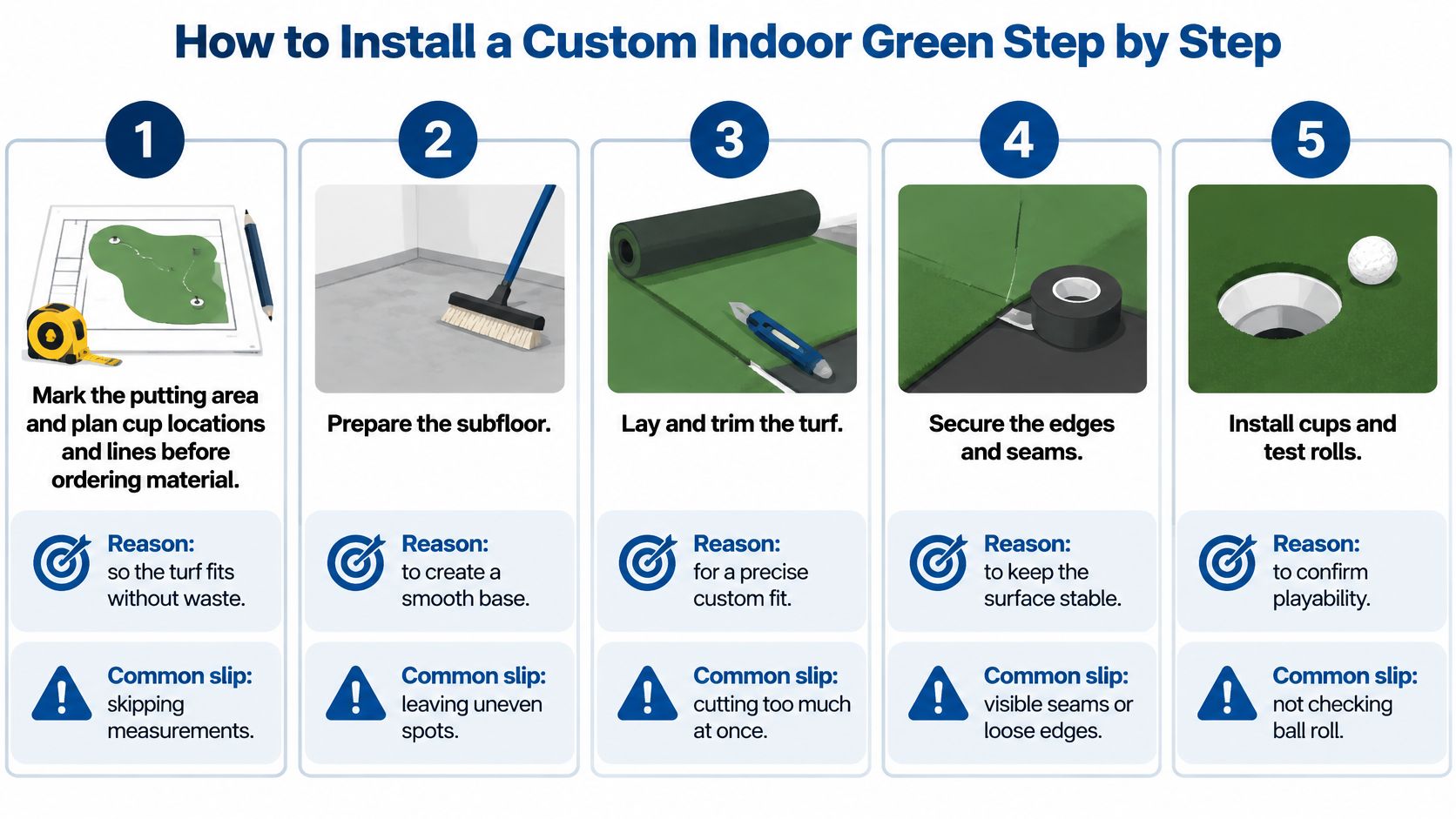
- Mark the putting area and plan cup locations before you order material. Measure the room, mark the longest putt you want and decide where the cups and the fringe line will sit. Turf cut to a plan fits without awkward offcuts and without a seam running through your favorite line. The slip is ordering first and designing around the roll width later.
- Check the floor with a long straight edge and a level. Drag the straight edge across the room in a grid rather than down one line, and mark every dip and ridge you find. A dip that feels invisible underfoot turns into a visible break once a ball rolls over it, and a short indoor putt magnifies small level changes into inconsistent stopping distances. The slip is checking the middle once and calling the floor flat.
- Prepare a firm, flat, dry base. On soil or a rough slab that means excavation, then a compacted layer of crushed stone or decomposed granite, then a weed barrier. Moisture and loose debris under turf become movement, and movement becomes a wrinkle. The slip is laying turf over a damp or dusty surface because it looks level from standing height.
- Lay the turf with pile direction consistent across the whole area. Unroll every piece the same way and check the lean by hand before you commit. Mixed orientation gives you a green that's quicker on one side, and brushing won't fix it. The slip is flipping one piece because it happened to be easier to drag that direction.
- Join seams tight and secure the edges. A seam should disappear under a ball and an edge should sit without a lip. A gap catches putts, and a lifted edge does the same thing more dramatically. The slip is trimming a seam twice and losing the overlap.
- Spread infill evenly and brush the blades upright. Infill supports the fibre and damps bounce, and brushing stands the pile so the ball rolls on the tips. Skip the brushing and you get a matted surface that reads slow and stays slow. The slip is dumping infill in piles and walking away.
- Test the finished green, then test again a week later. Take readings before the furniture goes back in and write them down. The surface settles in the first week, so a green that read 6.5 feet on Friday can read noticeably slower by the following weekend. The slip is trusting the day-one number forever.
What a finished green should look like
Consistent roll in both directions, seams you can't find with a fingertip, and blades standing evenly across the whole area. The purpose of testing after installation is documentation, because a green either delivers repeatable practice conditions or it doesn't, and a written log settles that faster than an opinion does. Keep the sheet. When you replace a cup or move furniture, you have a baseline to check against.
Durability, Cleaning and Care Over the Years
Wear on an indoor green doesn't spread evenly. It shows first on the putting line you repeat from the same spot, around the cup where feet and pulled balls land, and along the path from the door to the green, where grit rides in on shoes.
Indoor turf skips the sun, rain and mowing damage that outdoor grass takes. It still absorbs foot traffic, dust and spills, and all three change roll over months. Properly built and cared for, a quality artificial putting green lasts 15 to 20 years, and the care schedule is what decides which end of that range you get.
| Task | Frequency | Purpose |
|---|---|---|
| Brush pile upright | Weekly | Keeps blades standing so roll stays even |
| Remove dust and debris | Weekly to monthly | Stops dust from slowing the surface |
| Rinse and dry spills | As needed | Prevents staining, odour and backing damage |
| Check seams and edges | Quarterly | Catches lifting before it changes the roll |
| Top up infill | Yearly or when thin | Restores blade support and bounce |
| Repeat roll test | Every six months | Confirms the green still meets its target |
Brushing and dust removal matter more to roll than an occasional deep clean. Dust settles into the pile and slows the surface from the top down, and it does it gradually enough that you blame your stroke instead of the green.
Dust is the slowest saboteur in the room. It never looks like the problem, and it's usually the problem.
For spills, rinse with water, blot dry, and skip harsh chemicals that attack the backing. Then watch for the four signs of decline: flattened blades that won't stand up, infill that has thinned below the fibre, seams lifting at the edge, and a roll test that has drifted from your target over two readings.
Keep the routine simple. A weekly brush and dust pass, a quarterly seam and edge check, and a roll test every six months against the number you wrote down on day one. When you're comparing surfaces, polyethylene artificial grass matters less to roll than the base beneath it, which is the part no sample card can show you.
Waterloo Turf Indianapolis designs and installs custom putting greens for homes and commercial spaces across the Indianapolis metro, and every build starts with a compacted base, tight seams and a final power brushing so the surface rolls true from the first putt. If you'd rather measure your green than guess at it, we can walk your room, plan the cup locations and agree on a speed target with you before anything is ordered. Visit Waterloo Turf Indianapolis to start the conversation.