Best Artificial Turf for Putting Green: 7 Top Picks in 2026
Compare the best artificial turf for putting green projects in Indianapolis: top installers, turf specs, green speeds, pros and cons, and how to choose.
The best artificial turf for a putting green is the surface that rolls the same way twice, not the sample that looks best in a showroom. Short, dense fibers, the right sand infill, and a compacted base set speed and trueness. Brand names do not.
That bar is higher than it used to be. Edward S. Stimpson developed the Stimpmeter idea in the 1930s, and his 1937 measurements on six greens averaged 2.5 feet, according to the USGA Stimpmeter booklet. Readings collected from 1946 through 1973 also averaged 2.5 feet. In 1976 and 1977, USGA agronomists measured more than 1,500 greens and recorded an average of 6.5 feet. The modern Stimpmeter came out in 1978, when average green speed was about 6 feet 6 inches. A backyard green can look perfect and still roll like an old, slow course.
Indianapolis buyers have several capable installers and almost no public prices. I judge each option on golf-specific roll, published specs, and how the base is built. These seven are the ones worth quoting before you sign.
1. Putting Green Turf from Waterloo Turf
A practice green fails when the pile is too long or the base moves under it. Our putting surfaces pair durable nylon fibers with a short, dense pile and sand infill, so speed stays predictable on a home green or a commercial pad. The install can include custom contours and cups, plus site prep and drainage, and you skip the mowing and watering a natural green needs.
Roll quality is the acceptance test, not pile height on a spec sheet. The USGA GS3 system scores speed, smoothness, and trueness. The USGA Green Section treats smoothness of 0.0 to 5.0 as high-quality roll with little vertical bounce, and trueness of 0.0 to 1.0 as high-quality roll with little side drift. Across assessed natural greens in one field study, average smoothness was 3.85 and average trueness was 0.73. Those figures are a reference, not a synthetic-turf standard. After install, roll both directions and look for matched speed, minimal bounce, and almost no wiggle.
What the base has to do
Practical rule: Write the target speed into the quote, then test the finished green. A "tour-quality" phrase is not a spec.
Our build is excavation, a compacted crushed-stone or decomposed-granite base, a weed barrier, tight seams, secured edges, infill, and a final power brush. That stack is what keeps nylon from wrinkling through an Indiana freeze-thaw winter. Direct-to-soil installs are the ones that puddle and creep at the seams. The full sequence is on our putting green installation page.
- Nylon pile: Holds up to regular practice without going limp.
- Sand infill: Sets firmness and playing speed.
- Custom shape: Contours and cups matched to the yard.
- Year-round play: Weather-resistant, fade-resistant, UV-stable turf you can use at home.
It will not feel identical to bentgrass. You are buying a controlled surface, and the cost is an upfront project, not a weekend kit. See the service details at Waterloo Turf putting greens.
2. Southwest Greens of Indiana
Southwest Greens of Indiana designs custom indoor and outdoor greens across the state, plus lawns, pet turf, playgrounds, and commercial work. The company reports more than 500 putting greens and turf installations. Golf-specific pieces include an exclusive Golden Bear turf line, a proprietary sand-infill system, and green speeds described as 9 to 14 on the Stimpmeter. It also offers HydroChill turf cooling.

Cooling claims need a reality check before you pay for them. A 2025 field case study measured artificial turf 24.1°C hotter than natural grass at midday. Penn State research found irrigation cut surface temperature by about 15°F, and that drop lasted roughly 200 minutes. Watering is a break, not a fix. Shade, orientation, and when you practice matter as much as the fiber.
- Golf-specific system: Turf and infill aimed at putting, not general lawn grass.
- Project range: Homes, businesses, and institutional sites.
- Speed claim: Confirm how they will calibrate that 9 to 14 range on your pad.
There is no public price. Book a consult, then confirm the exact turf, infill, and how speed gets set. Coverage and scheduling should be confirmed on Southwest Greens of Indiana.
3. Tour Greens Indiana
If the green is only one piece of the yard, a dealer who also builds short-game areas and courts is easier to manage than three separate crews. Tour Greens Indiana is a certified Indiana dealer and installer for Tour Greens and XGrass, with indoor and outdoor greens for homeowners and golf facilities.
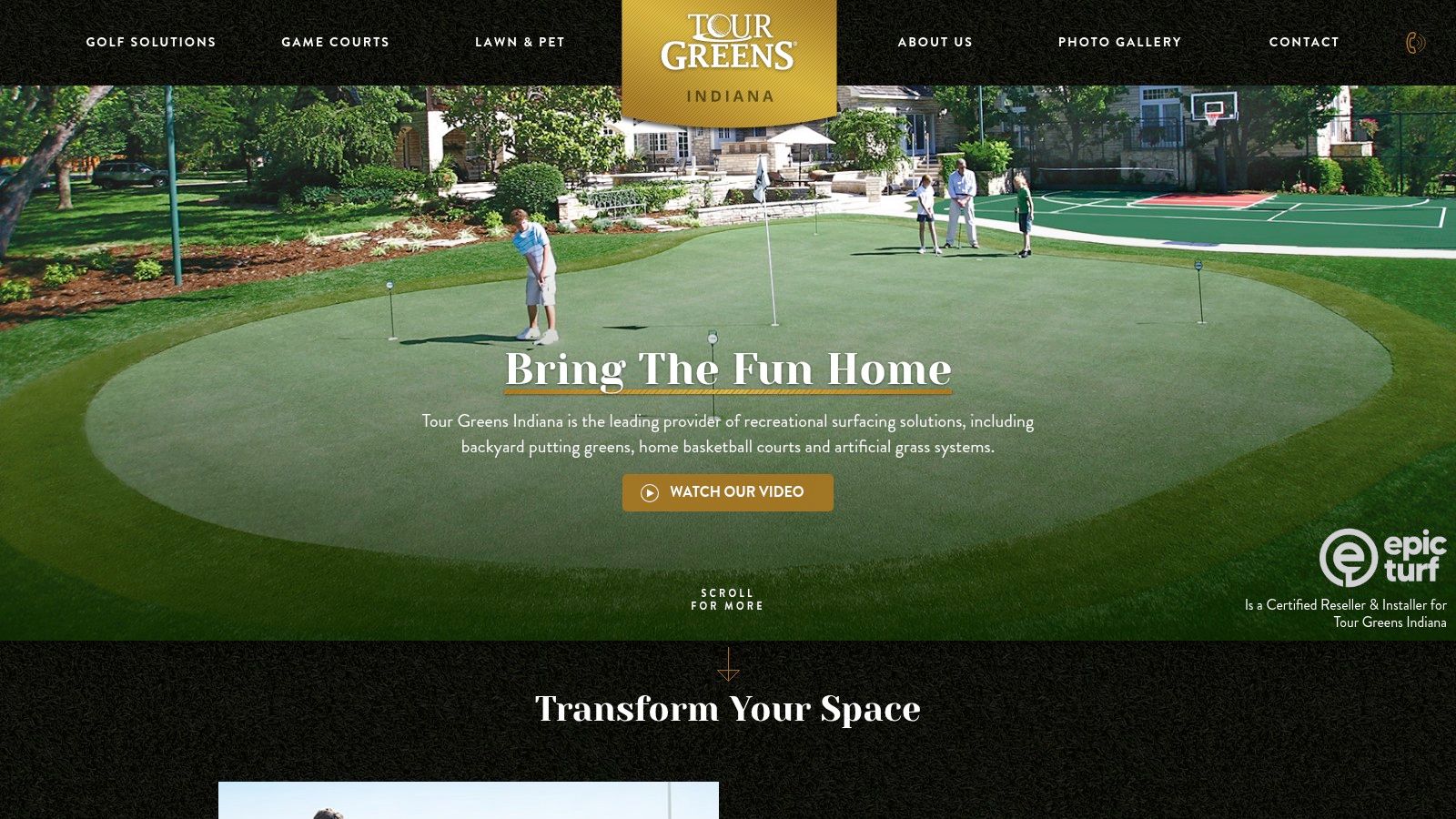
The site shows Indianapolis contact details and a project gallery, which helps you see finished shapes before a sales visit. What it does not show is a public price, a fiber spec, or a review total. Ask for the pile, the infill weight, and two recent references you can walk.
Cups, flags, and fringe change how a small green gets used. Our notes on backyard putting green accessories cover the add-ons that belong in the same quote as the turf, so you are not buying cups after the seams are glued.
A multi-surface bid is only a bargain if the putting pile is specified separately from the lawn or court turf.
Start with the gallery, then request product sheets, at Tour Greens Indiana.
4. SYNLawn Indiana
SYNLawn Indiana is a Central Indiana installer for residential and commercial greens, including Indianapolis and nearby suburbs. The golf line includes Precision Putt, a nylon surface with a stated Stimp speed of 10 to 12.5, UV protection, and compatibility with TrueStop underlayment for receiving approach shots. Indoor and outdoor greens are both on offer, along with lawn, pet, playground, and commercial turf.
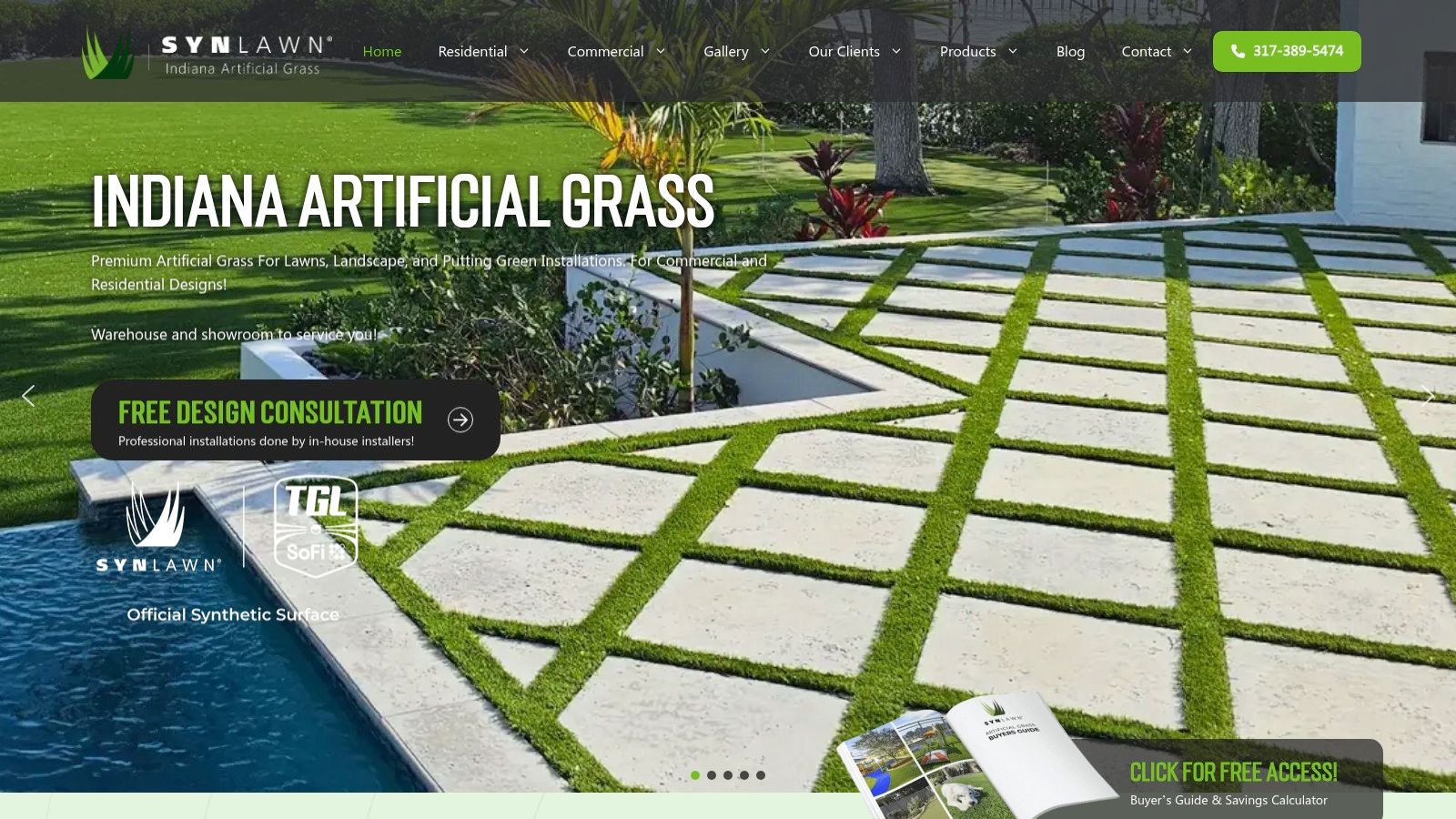
Publishing a speed band is useful. It is not the whole spec. Nylon putting pile and longer surrounding blades are different products, and a fringe made from the wrong yarn will grab the ball. If you are comparing fiber types, our polyethylene artificial grass breakdown shows where polyethylene belongs and where a tighter putting yarn is the better call.
- Named golf turf: Precision Putt, not a generic lawn SKU.
- Approach shots: TrueStop is an option, so confirm it is in the quote if you chip onto the green.
- Warranty: Model, underlayment, and coverage change by product. Get them in writing.
No public install price showed up. Pricing is a quote. Details are at SYNLawn Indiana.
5. Greene Exterior Design
Greene Exterior Design is an Indianapolis-area outdoor company that builds custom greens with American-made Celebrity Greens turf. It reports more than 150 greens in the greater Indianapolis area, from tight side yards to layouts inspired by course holes. That local count is company-reported, so treat it as a lead and ask for recent addresses you can see.
This is a design-led shop. It can sit a green inside a larger outdoor renovation, which helps when the patio, planting, and putter all have to share one plan. The trade-off is documentation. The putting-green page did not list public pricing, a pile spec, or warranty terms.
- Named turf: Celebrity Greens, so you can request the data sheet yourself.
- Awkward lots: Compact and odd-shaped layouts are part of the pitch.
- Proof: Ask for three finished greens from the last two seasons, not a lifetime total.
If the green is part of a full yard rebuild, start at Greene Exterior Design. If you only want a practice pad, make them spell out ball roll before you talk about furniture.
6. American Greens
American Greens runs a dedicated Indianapolis putting-green service for custom backyard greens, indoor practice greens, and larger putting courses for homes or businesses. The company says it has served this market since 1999 and installed more than one million square feet of synthetic turf. Both figures are company-reported.
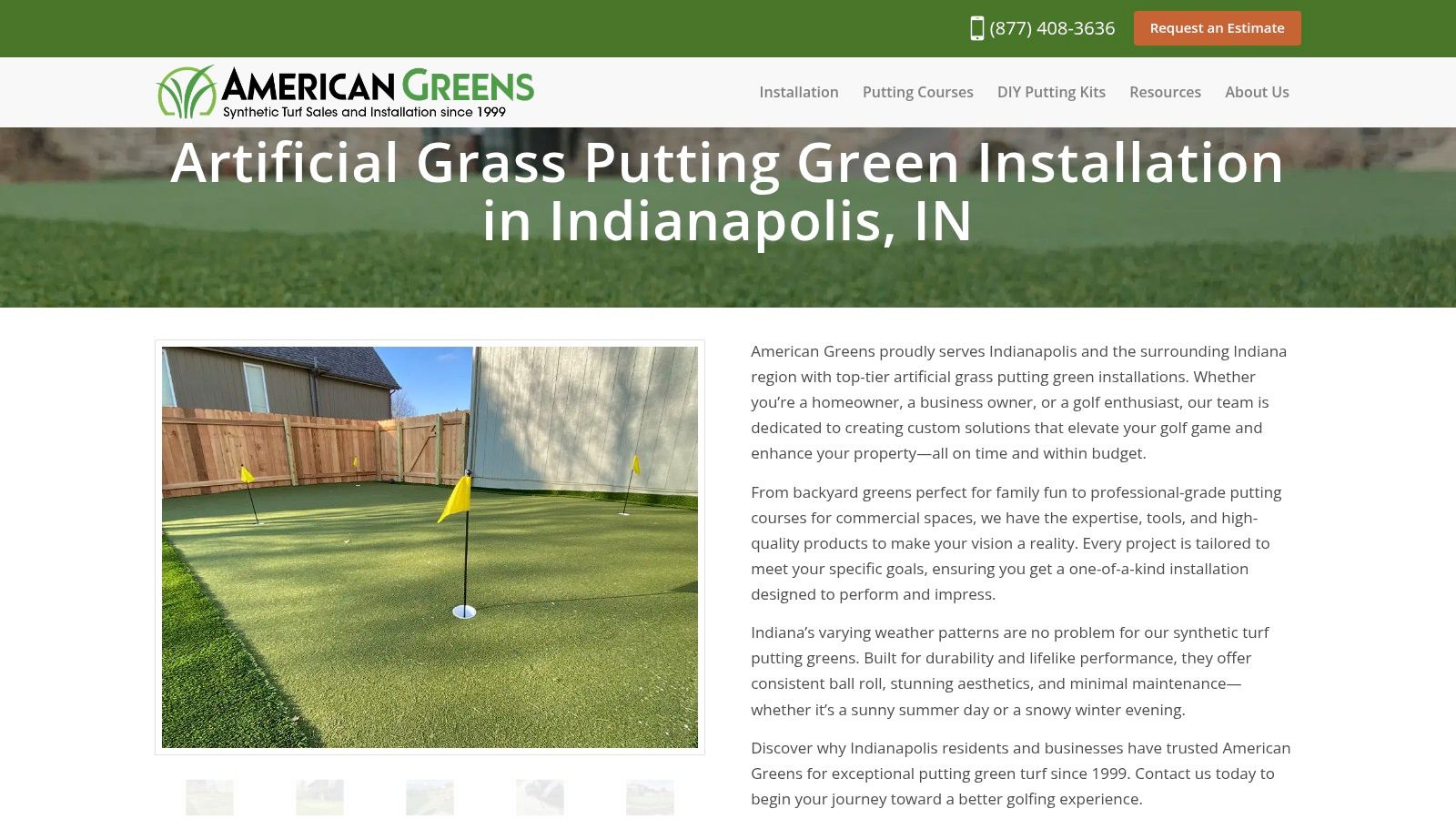
Scale is the selling point. A firm that builds full putting courses is used to cups, breaks, and bigger footprints, and the site describes an estimate-to-installation path for Indianapolis and nearby communities. The Indianapolis page did not publish a turf brand, a Stimp number, or a price.
Before you book the estimate, pin down three things.
- Who builds it: Confirm the local crew, not just a national brand name.
- Which product: Get the turf brand, pile, and infill in the proposal.
- What is covered: Warranty length and what voids it, including drainage failures.
An estimate is required either way. The local page is American Greens Indianapolis putting greens.
7. B&F Landscaping
B&F Landscaping is an Indianapolis-area company that adds custom putting greens next to artificial lawns, pet turf, and outdoor living work. It serves Indianapolis plus Carmel, Fishers, and Westfield. The described process includes site assessment, base preparation, drainage, edging, and infill, and the site shows local project photos.
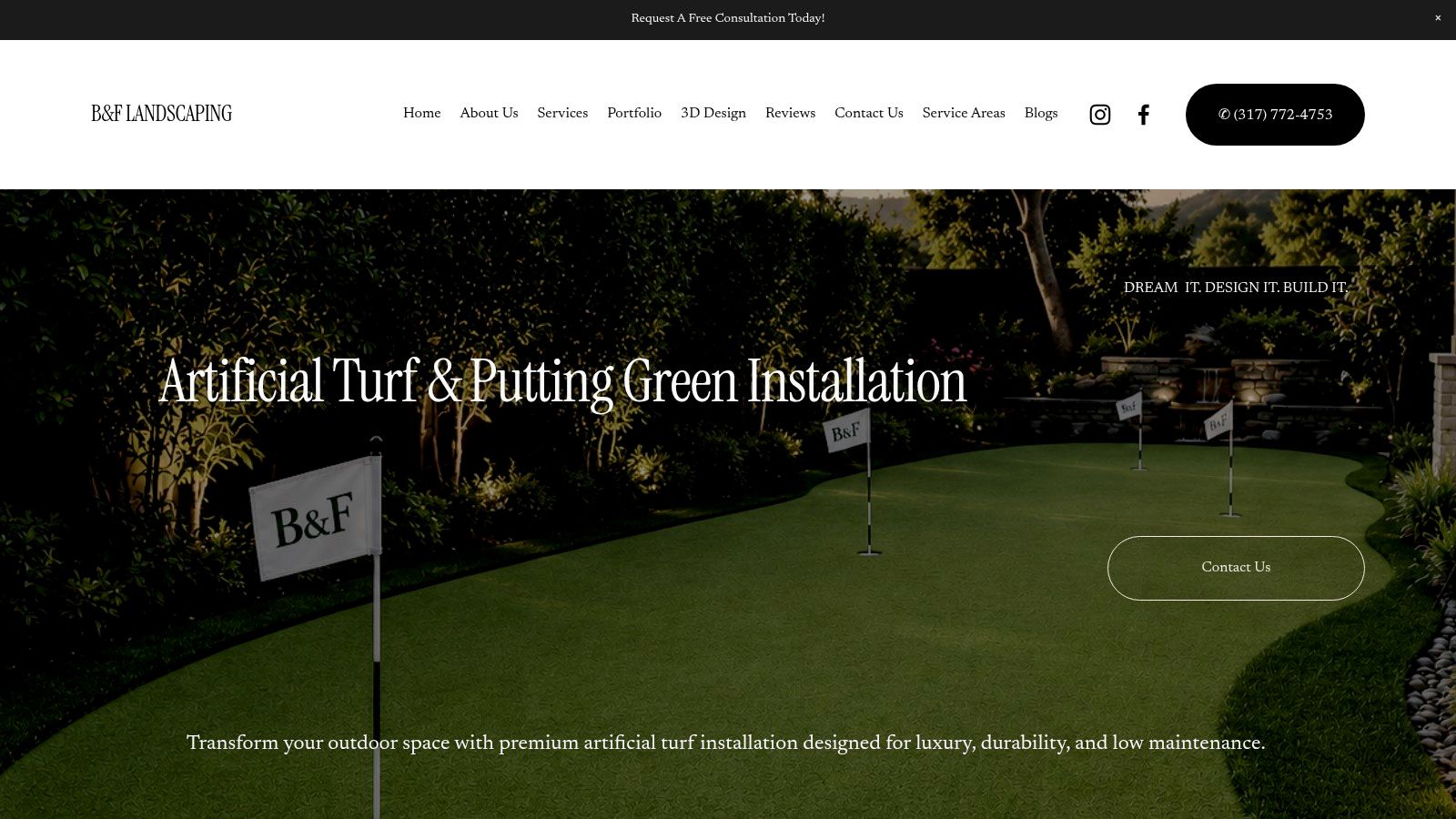
That base talk matters more than a ranking of blade lengths. The USGA says synthetic putting greens generally rely on surface drainage rather than subsurface pipes, often with a slight raised, "turtle-backed" profile to shed water and cut algae risk, and that well-built, maintained synthetic greens can last 10 years or more. The same account notes that Penn State flags poor grading and weak internal drainage as two major construction problems in U.S. synthetic turf systems. A premium pile over a soft, flat base will puddle, wrinkle, and wander at the seams. A plainer turf on a graded, compacted pad will putt better.
The page did not name a golf-turf brand, a ball-roll spec, a price, or a putting-green warranty. Ask which crew has built greens, and ask to see a comparable one. Details are at B&F Landscaping putting greens.
Putting Green Turf and Installer Comparison
| Item | Golf-Specific Turf | Published Specs | Best For |
|---|---|---|---|
| Putting Green Turf, Waterloo Turf | Durable nylon; short, dense pile with sand infill | No numeric specs; designed for consistent ball roll and speed | Custom residential or commercial practice greens |
| Southwest Greens of Indiana | Golden Bear turf with proprietary sand-infill system | Green speeds of 9–14 on the Stimpmeter | Buyers seeking golf-focused turf and a specified speed range |
| Tour Greens Indiana | Tour Greens and XGrass products | Detailed turf specifications not provided | Indoor or outdoor greens and multi-use recreational projects |
| SYNLawn Indiana | Precision Putt nylon; compatible with TrueStop underlayment | Stimp speed of 10–12.5; UV protection | Central Indiana buyers wanting published golf-turf details |
| Greene Exterior Design | American-made Celebrity Greens turf | No detailed turf specs provided | Custom greens integrated with landscaping or outdoor-living projects |
| American Greens | Synthetic turf; specific golf-turf product not identified | No product specs provided | Residential or commercial greens, including larger putting courses |
| B&F Landscaping | Golf-turf brand and ball-roll details not provided | No golf-specific specs provided; installation includes base prep, drainage, edging, and infill | Greens combined with landscaping or other yard improvements |
How to Choose and What to Ask Before You Commit
Match the installer to the job you have. Pick the shop with published golf specs if speed is the point. Pick the design firm if the green has to fit a strange lot or a full outdoor plan. Pick the multi-surface crew if the green shares a bid with a lawn, a pet run, or a court. A pretty rendering does not replace a fiber name.
Take the same questions to every quote.
- Turf brand and pile: Nylon or another putting yarn, not a general-purpose blade cut short.
- Target speed: A Stimp range, plus how they will test it after infill.
- Base: Crushed stone or decomposed granite, compacted, never turf on native soil.
- Drainage: Slope, where water leaves the pad, and a raised profile on clay or a low spot.
- Warranty: Years, what is covered, and whether DIY work voids it.
Most backyard greens run 200 to 500 square feet. Tight lots can work at 100 to 200 square feet. In Indianapolis, installed artificial turf typically costs $8 to $15 per square foot. With proper care, a high-quality artificial putting green lasts 15 to 20 years. Built-in drainage should keep water from pooling, and the surface should stay soft and springy with a true roll. Colors and textures vary, so look at a sample in daylight, not only on a screen.
Get two or three written quotes. Line up the turf name, infill, base depth, slope, and warranty on one page. Compare those lines before you compare the totals.
Waterloo Turf Indianapolis designs and installs custom backyard putting greens across the Indianapolis metro, with professional-grade turf, cups, contours, and a compacted base built for a consistent roll. If you want a year-round practice surface without mowing or watering, we can price the green as its own project or alongside lawn, pet, or sports turf. Visit Waterloo Turf Indianapolis to request an estimate and compare a real spec, not just a photo.