Artificial Turf Dog Park: How to Design One That Lasts
Plan an artificial turf dog park with the right drainage, slope, heat limits and sanitation routine. Specs, build steps and permit checks included.
The most common advice about an artificial turf dog park is to buy a permeable pet turf, add odor-control infill, and hose it down. That advice skips the decisions that determine whether the park stays usable: where contaminated water goes, how hot the surface gets, and who removes the waste.
Drainage doesn't equal sanitation, and durability doesn't equal heat safety. A successful installation starts with a site that can handle water, a layout that spreads wear, and an operating plan that staff can follow. For Indianapolis homeowners, HOAs, and property managers, those requirements matter more than how green the sample looks.
Design Specs to Check Before You Build
Core design specifications for an artificial turf dog park
| Design element | Specification | Why it matters |
|---|---|---|
| Finished surface slope | About 1.5% to 4.5% | Moves water toward drains instead of letting it pool |
| Setback from floodplains or surface water | At least 50 feet where feasible | Keeps runoff and contamination away from waterways |
| Perimeter curb | At least 6 inches high and 8 inches wide, with weep holes where needed | Contains infill and releases trapped water |
| Subsurface drainage | Completed before surfacing | Prevents ponding, odor retention, and surface movement |
| Hose bib or irrigation connection | Required on site as a design provision | Allows rinsing of urine and fecal residue |
| Subgrade | Well drained, with clay-dominated and flood-prone sites avoided | Prevents backing deterioration and uneven surfaces |
Treat these as design checkpoints, not a substitute for local approval or site engineering. A drainage drawing should show the existing ground, proposed finished elevations, collection points, and discharge destination. An arrow pointing toward the property line isn't an adequate drainage plan.
The surface needs a continuous fall, including around gate posts, curbs, and water stations. A contractor can hit the intended grade across the middle while leaving a trapped pocket at the entrance. Check those transitions with a laser level and straightedge before accepting the grading.
Check access as carefully as drainage
A hose connection only helps if the hose reaches the entire enclosure without blocking the entrance. Mark its location on the plan, check the route around fences, and provide somewhere to store cleaning equipment. Staff shouldn't have to drag a hose through occupied play areas to reach a dirty corner.
Containment needs similar attention. A curb that holds infill can also trap water if the drainage openings are missing or blocked. Fence posts, gate thresholds, and curb openings should be coordinated rather than installed as unrelated trades.
Before ordering turf: Verify the ground, the water supply, and the discharge route. None becomes easier to correct after the surface is installed.
Walk the lot with the proposed drawing and ask:
- Does the ground drain before turf goes down? Don't count the backing as a remedy for unsuitable soil.
- Can cleaning water reach every corner? Include areas behind benches and around gates.
- Does the site clear the applicable water setback? Confirm the boundary with the reviewing authority rather than estimating it from a fence.
Permits, Stormwater and Material Records to Gather
A turf specification does not settle an approval review. Before committing to materials, confirm local requirements for wastewater, stormwater, setbacks, and product documentation with the authorities responsible for the site.
For an Indianapolis-area project, identify which municipality, utility, property owner, and association must review the work. Send each reviewer the same site drawing, including the proposed drainage arrangement, so approvals refer to a consistent plan.
Assemble an approval packet
Confirm the wastewater route. Ask the applicable local authority whether washing a pet-use surface requires wastewater permits or is subject to discharge restrictions. If the proposed outlet is not acceptable, the drainage design may need to change before the park opens.
Ask about stormwater review. Provide the collection layout, proposed outlet, and any bioswale or rain garden for review. A planted depression should not be assumed to meet local requirements; clarify its status before excavation to avoid changes to the perimeter later.
Collect written material records. Request the turf backing specification, infill composition, and any available PFAS testing documents for the products under consideration. A statement that turf is suitable for pets does not identify which components were tested or show that delivered materials match the submitted specifications.
Check HOA approval requirements. Include the turf, fencing, gates, visible edging, and equipment locations in the application. Approval for landscaping may not cover a dog enclosure, so confirm what the association requires for this use.
Confirm site-specific setbacks. Ask the municipality which restrictions apply to surface water, drainage, property lines, or other features. A layout may need revision if the enclosure conflicts with a local setback, even when the turf material is acceptable.
Make the records usable after construction
Keep approved drawings, product information, outlet permissions, and maintenance instructions together. Document any substitutions before installation, so the completed work can be compared with the approved materials.
Assign someone to resolve unanswered approval questions and retain the written responses. An installer's assurance is not a record of approval, and an unanswered email does not establish permission to discharge wash water.
Approval checkpoint: Hold the surface order until the discharge destination and material acceptance are clear.
These records help the maintenance contractor identify what was installed and understand the site's approved discharge arrangements. Good drainage alone does not establish that wash water can be discharged or that the selected materials meet local requirements.
Layout for Mixed Dog Sizes and Heavy Traffic
Concentrated running, turning, and gathering can wear natural grass into bare soil. That's the strongest case for turf, but it's also a reason to zone the park before selecting the surface.
Dog parks are established public-use infrastructure, not fenced lawns. An academic review of dog parks estimated approximately 2,200 dog parks in the United States by 2013. That scale makes circulation, supervision, and maintenance access central design considerations.
Follow the dogs' likely routes
Say an HOA plans a park with the entrance opposite a drinking station. Dogs entering the enclosure will cross the same strip, gather around the water, and turn back toward arriving owners. Placing a bench in that strip adds people to an already busy route.
Instead, position seating outside the running lane and give the water station a serviceable surround. Keep maintenance access available without requiring equipment to cross the entire play area.
- Separate play areas: Provide distinct spaces for small and large dogs so owners can choose an appropriate play environment.
- Double-gated entry: Use an entry vestibule so an arriving dog doesn't have a direct path from the play area to the outside.
- Serviceable wear zones: Make gate approaches and gathering areas accessible for brushing, inspection, and eventual repair.
- Quiet shaded space: Put resting areas outside the busiest chase routes.
- Flexible closures: Allow a worn or contaminated portion to be isolated without shutting the whole enclosure.
Test the drawing on foot
At an existing park, stand near the gate during busy use and mark gathering points, running lanes, and owner waiting areas on a sketch. For a new park, walk the proposed routes with the gate swings and furniture positions marked on the ground.
Repeat observations in a different season where the project schedule allows. Sun exposure and owner preferences can shift where dogs gather.
Turf doesn't eliminate concentrated wear. A layout that lets staff rotate access, reach seams, and isolate a problem area is easier to operate than a single uninterrupted field with no service strategy.
How to Build the Base and Drainage in Order
Turf isn't a waterproof finish that conceals a drainage problem. It's the upper layer of a system, and the construction sequence determines whether that system works.
The Fairfax County dog park guidance supports a finished slope of approximately 1.5%–4.5%, a separation of at least 50 feet from floodplains or surface waters where feasible, and a perimeter curb at least 6 inches high inside the finished grade and 8 inches wide, with weep holes where needed. Those are planning recommendations, not a statement of Indianapolis code.
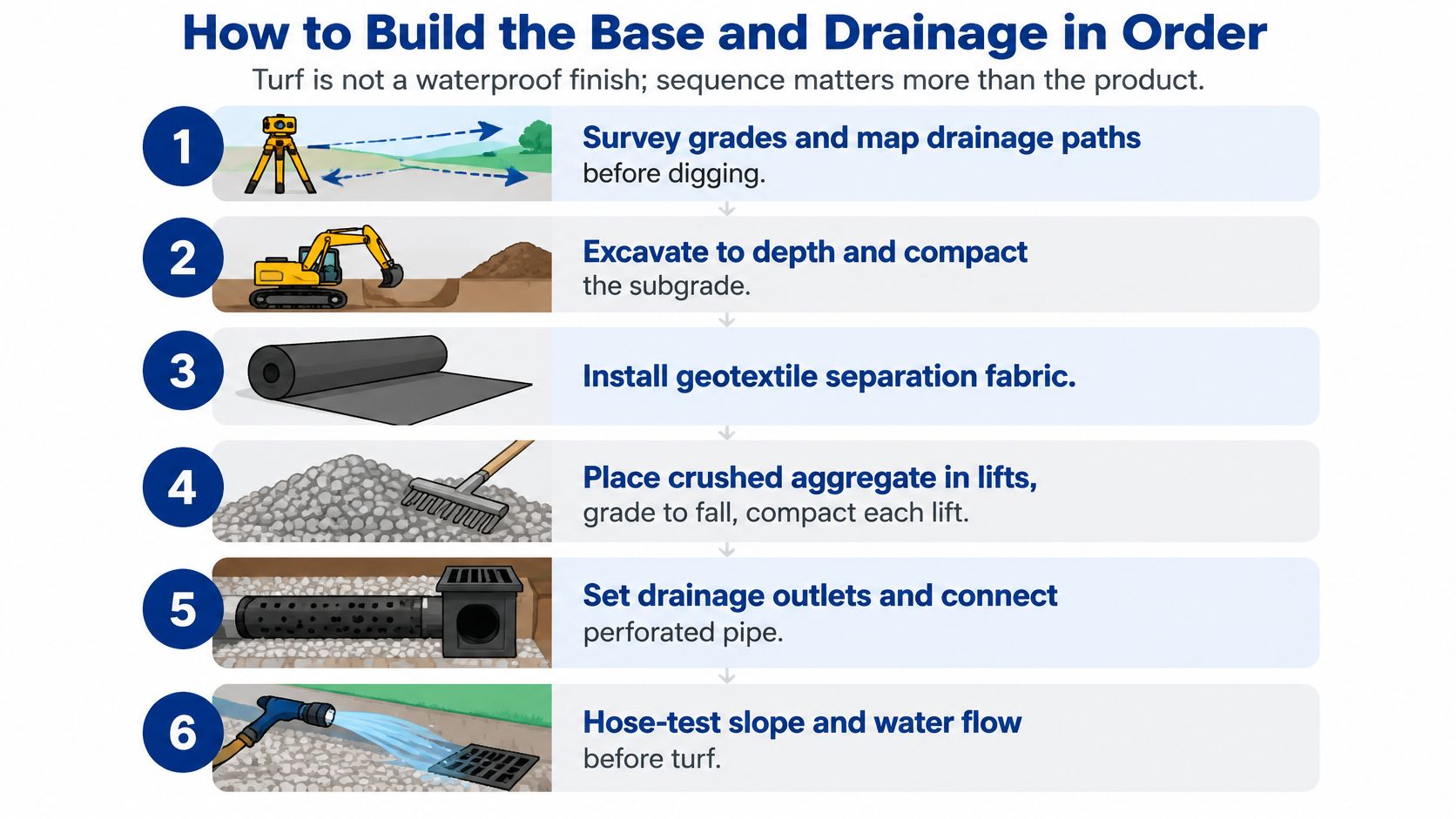
The base-construction sequence is illustrated below.
Build and verify the concealed work
Survey grades and map drainage paths before digging. Use a laser level to establish elevations at entrances, boundaries, collection points, and the outlet. The common mistake is grading only the play surface without checking whether the outlet is low enough to receive the water.
Remove unsuitable soil to reach a stable formation. Strip organic material and remove soft pockets rather than burying them under stone. Where separation fabric is specified, install it to keep the soil and aggregate from mixing, but don't treat fabric as a drainage cure.
Construct and compact a permeable aggregate foundation in lifts. Select aggregate for both stability and the drainage design, then check levels as each lift is compacted. Rushing this stage leaves depressions that become difficult to repair without lifting the turf.
Install drainage lines and accessible cleanouts. Coordinate pipe trenches with the aggregate work and verify that every collection point connects to the intended outlet. Burying a system without cleanout access makes later inspection and flushing unnecessarily disruptive.
Form the perimeter containment. Coordinate curbs, weep openings, fence posts, and gate thresholds before the turf arrives. A solid perimeter installed without a water-release detail can turn an otherwise permeable base into a basin.
Finish the surface without hiding defects
Place, seam, and secure the turf. Dry-fit the rolls, check pile direction, and follow the specified seam and edge-fixing system. Don't stretch material over an uneven base and expect tension to correct the grade.
Install infill and power-brush the fibers upright. Distribute the specified infill evenly and use equipment suited to the turf system. Dumping material into piles and making a quick brushing pass can leave uneven support and buried fibers.
Flood-test before opening. Observe the entire route from the wetted surface to the outlet, including corners and gate transitions. Mark persistent wet spots and correct the cause before dogs begin using the enclosure.
For a closer explanation of material selection and foundation preparation, use this guide to the artificial grass base layer alongside the project-specific drainage drawing.
Perimeter bioswales or rain gardens can add a stormwater-treatment step when properly designed and approved. They don't authorize contaminated discharge or compensate for a blocked outlet.
Poor subgrade drainage can leave ponding, retained odor, deteriorating backing, and surface movement. More cleaning won't repair the ground beneath the turf.
Managing Heat Before Dogs Reach the Surface
Good drainage does not make turf cool. A surface can look clean and stable yet become too hot for paw contact, so heat safety needs its own operating plan.
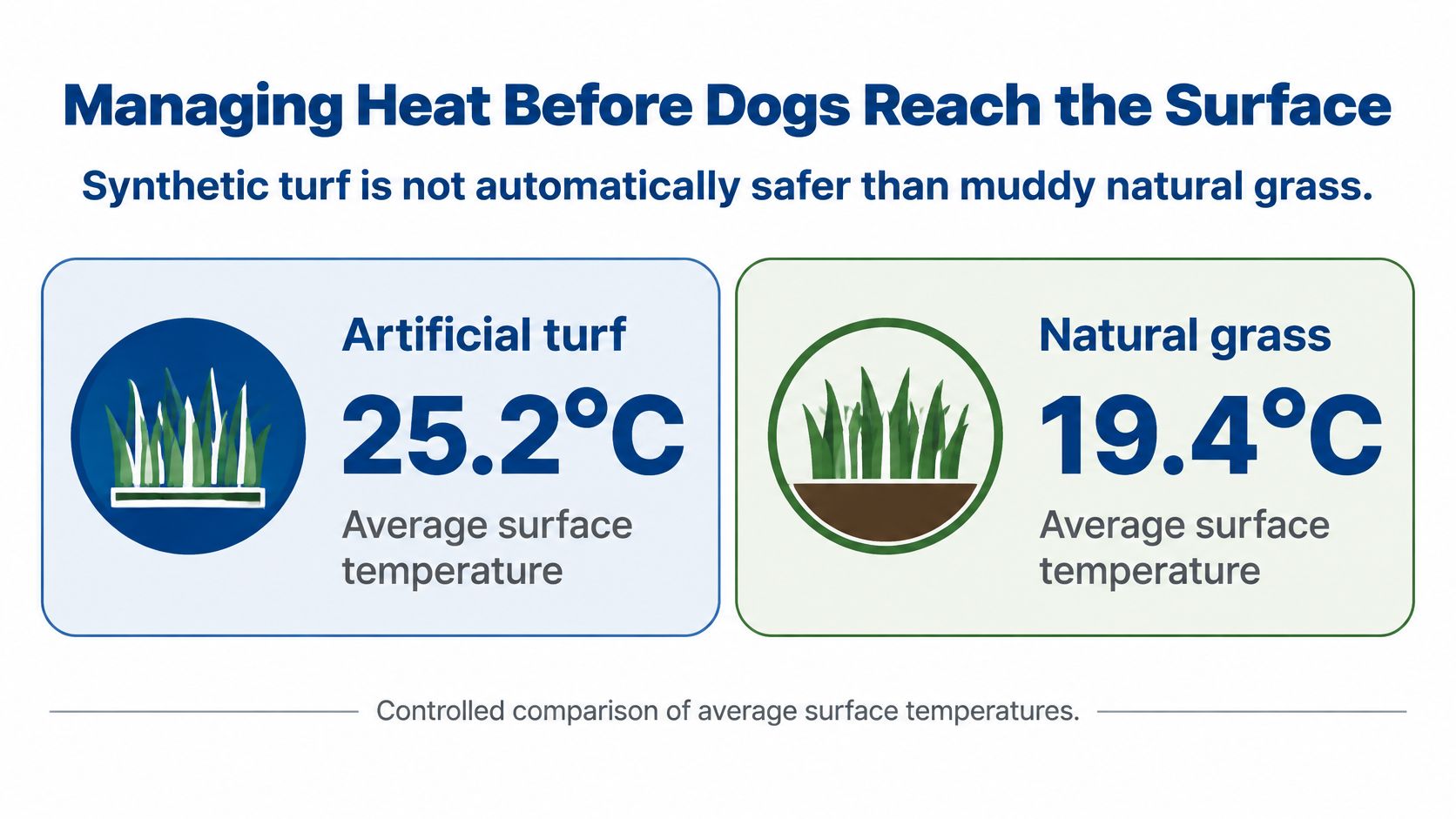
A controlled turf comparison reported average surface temperatures of 25.2°C for artificial turf and 19.4°C for natural turf, and advised caution when environmental temperatures exceeded 25°C. Separate summer surface measurements found artificial turf reaching 72°C, a temperature capable of causing irreversible skin burns in about 10 seconds. Natural turf in that test peaked at 39°C.
Reported surface temperatures and practical responses
| Condition | Reported value | Action |
|---|---|---|
| Air temperature above 25°C | Caution threshold in a controlled comparison | Add shade and water, restrict midday use, and check the surface |
| Natural turf in summer test | Peak of 39°C | Treat as a comparison, not proof that every grass surface is safe |
| Artificial turf in summer test | Peak of 72°C | Keep dogs off a dangerously hot surface; burns may occur in about 10 seconds |
| Artificial versus natural turf in controlled comparison | 25.2°C versus 19.4°C average | Expect synthetic turf to be hotter and plan cooling |
| Synthetic turf in earlier measurements | Temperatures reported as high as 160°F | Provide shaded rest areas and use water for temporary cooling |
These readings were taken under different conditions. They do not predict the temperature at a particular Indianapolis site, and the air-temperature caution point is not a universal safe-use boundary.
Turn temperature checks into an entry rule
Use an infrared thermometer to compare sunny turf, shaded turf, and gathering areas before opening. Check during the hottest periods of use rather than relying on a morning reading.
A brief hand check can flag obvious heat, but it is only a rough screen. Don't hold your hand against a surface that feels hot, and don't assume that tolerable contact means dogs can safely run on it.
- When conditions are cooler: Keep drinking water and shade available, and inspect sun-exposed sections.
- When heat builds: Restrict midday access and direct dogs to shaded or cooler alternatives.
- When the surface is uncomfortably hot: Keep dogs off, cool the area if appropriate, and reassess before reopening.
Watering can lower surface temperature temporarily, but turf may heat up again. Cooling also takes staff time and depends on a functioning drainage route.
Design for the hottest occupied hours
Locate shade where dogs rest and wait, rather than wherever a shade sail is easiest to install. Cooler-colored material may help, but it cannot replace temperature checks or a clear closure procedure.
Daily Sanitation Beyond Drainage
Perforated backing and enzyme cleaners aren't complete sanitation systems. Liquid passing through the surface doesn't establish that fecal residue, organic debris, or contaminated moisture has been removed.
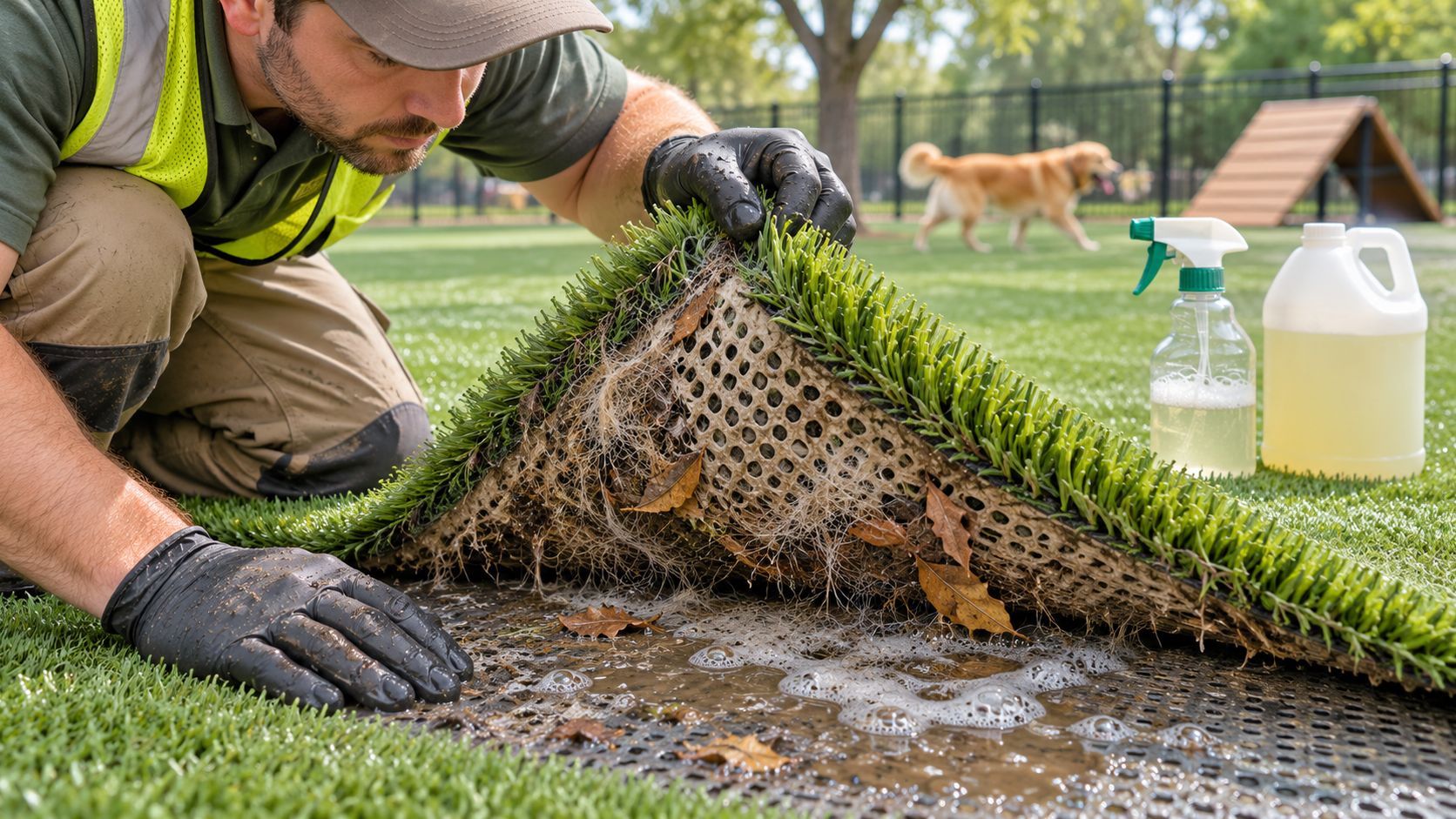
King County's guidance for outdoor animal areas identifies cleaning and drying difficulties associated with artificial turf. Organic material and wash water can remain around blades and backing, while runoff can transport contaminants toward soil, storm drains, or sewers.
The maintenance image below highlights an important point: cleaning concerns the backing and retained residue, not just the visible fibers.
Give the daily routine a named owner
- Remove solid waste: Walk the entire enclosure and pick it up as you would on natural grass. Don't rely solely on owners noticing every deposit.
- Rinse targeted areas: After removing solids, rinse gate approaches, marking spots, and other heavily used areas toward the designed drainage route.
- Lift flattened fibers: Use a suitable synthetic-turf brush in worn zones, avoiding tools that damage the backing or scatter infill unnecessarily.
- Inspect low points: Look for retained water, slippery residue, and persistent odor around drain inlets.
- Service the entrance: Empty waste bins, replenish bags, and remove buildup around their bases.
- Record recurring problems: Note the location, weather conditions, cleaning action, and whether the problem returns.
Urine drainage is a movement-of-liquid function. Sanitation requires removal of contamination, appropriate cleaning, and an opportunity for the assembly to dry.
An odor-control product isn't automatically a disinfectant. Where disinfection is necessary, use a product approved for the intended application, confirm compatibility with the turf, and control access during treatment and drying.
Use a weekly condition check
Inspect accessible backing at service points without pulling apart sound seams. Check infill distribution, secure edges, drain inlets, cleanout access, and the areas beneath movable furniture.
Flush drains when inspection indicates buildup and the approved maintenance procedure calls for it. Don't push an obstruction farther into the system or send cleaning wastewater to an unapproved destination.
The artificial turf cleaning guide can help organize equipment and surface-care tasks. A shared dog park still needs a schedule matched to its actual contamination load.
Maintenance test: If the same wet spot or smell returns after cleaning, investigate the assembly and outlet instead of repeatedly adding deodorizer.
Close an affected zone when staff can't remove contamination or resolve retained wastewater. Continued access turns a repair problem into an operating problem.
Confirm the Site Before You Commit to Turf
An artificial turf dog park needs to pass drainage, heat-management, and sanitation tests. The ground must support the drainage system, the layout must provide a workable response to hot surfaces, and the owner must fund and assign routine care. If any requirement remains unresolved, change the design or reconsider turf for that location.
Bring evidence to the site assessment
A useful assessment starts with existing conditions rather than a preferred roll of turf. Bring a site plan showing boundaries, gates, nearby water, utility locations, proposed shade, and the drainage outlet.
Include photographs after rain if they're available. Mark where water collects, where soil stays soft, and where maintenance equipment can enter.
- Site records: Supply approval correspondence, surveyed information, and any existing drainage drawings.
- Operating plan: Identify who will clean the surface, inspect it during hot weather, and restrict access when needed.
- Material requirements: Bring the product documentation and environmental questions that must be resolved before purchase.
- Budget scope: Include foundation work, drainage, shade, water access, and ongoing care rather than comparing turf-only prices.
Use the pet turf cost planning guide to organize the estimate around the full installation. A cheaper surface doesn't offset an omitted outlet or inaccessible cleaning connection.
Make acceptance criteria part of the proposal
At Waterloo Turf Indianapolis, our pet turf uses a strong base that prevents dogs from digging and is made from non-toxic materials containing no harmful chemicals or pesticides. With proper care, it can maintain its look and function for well over a decade. Those product characteristics still need a site-specific plan for public use.
The business page provides a starting point for arranging a site review.
Request a written scope that identifies base preparation, drainage verification, surface acceptance, and the handover of maintenance instructions. Commit when the site and operating plan are ready, not merely when the sample is approved.
Waterloo Turf Indianapolis provides site assessment, drainage planning, base construction, and pet turf installation for residential and commercial properties. Visit Waterloo Turf Indianapolis to request a site review, and bring your site plan, drainage outlet locations, and proposed cleaning routine so the discussion starts with the conditions your dog park must handle.