Artificial Grass Installation Finance: Costs Compared
Compare loans, payment plans and HELOCs for artificial grass installation finance, estimate monthly payments and check contract terms.
The most repeated piece of advice about paying for artificial grass is to pick the plan with the lowest monthly payment. That advice is backwards. The monthly number is the easiest figure for a lender to advertise and the easiest figure for a homeowner to misread, because it moves whenever the term lengthens, whether or not the total cost improves. Stretch a balance over ten years instead of five and the payment drops by nearly 40% while the interest roughly doubles.
So the useful question isn't "what's the payment?" It's "what does this yard cost me in total, and what will it cost again before I've finished paying for it?" Financing a lawn is different from financing a sofa, because a synthetic surface has a service life and an end-of-life bill attached. This guide walks through artificial grass installation finance the way it should be explained at the kitchen table: what each route really costs, who tends to get approved, which clauses change the arithmetic, and how to plan for the replacement cycle instead of being surprised by it.
Financing Options for Artificial Grass at a Glance
A turf quote is a stack of routes, not one monthly figure. Cash, a contractor plan, an unsecured loan, home equity, and a credit card each change the total you pay, and whether that bill can outlast the lawn.
| Option | How it works | Typical cost | Best fit | Main risk |
|---|---|---|---|---|
| Cash or savings | Pay the full installed price upfront | No interest; you pay the installed price once | Buyers with reserves and phased projects | Uses savings you may need elsewhere |
| Contractor or point-of-sale plan | Monthly payments arranged at the quote | Interest-free promotional window, then a set APR with deferred interest on the original balance | Mid-size projects needing fast approval | Retroactive interest if a promotional balance is not cleared on time |
| Unsecured personal loan | Fixed payments over 2 to 12 years | Rate set by credit, amount and term | Buyers without home equity | Higher rate for weaker credit |
| Home-equity loan or HELOC | Borrow against the value of your home | Lower interest than an unsecured loan, charged on the outstanding balance | Owners with equity who want a lower rate | Your home secures the loan |
| Credit card | Revolving balance paid monthly | High card APR on any balance that carries past the statement | Small balances repaid quickly | High interest when balances carry |
Installed artificial turf in Indianapolis typically runs $8–$15 per square foot. That range is the cash price of the yard. Financing does not shrink the square footage. It adds interest on top, and a long term can still be open when a hard-used surface is due for replacement.
The right-hand column is the part a quote rarely spells out. Cash costs nothing in interest, but it empties a reserve you might need for a furnace or a roof. A contractor plan is the fastest yes at the quote desk. A promotional period works like a library loan: free if the balance is back before the due date, expensive if it is not. Miss that date and deferred interest is usually calculated on the original amount, not the remainder.
Unsecured loans turn the job into a fixed payment. Credit score, loan size, and term length all move the rate. Home-equity products usually price below that unsecured rate because the house stands behind the loan. That lower rate and the lien are the same decision. A credit card stays tolerable only when the balance is small and gone within a cycle or two.
Finance the turnkey installation: excavation, a compacted base, drainage correction, edging, seams, infill, and labor. A plan built on turf material alone produces a payment that cannot deliver the yard on the page. Compare the dollars you will pay in full, then check whether the note ends before the surface does.
Estimating Payments and a $15,000 Three-Route Case
A lower monthly payment can conceal a higher total cost. To compare financing fairly, start with three inputs: the amount financed, the annual percentage rate (APR), and the term in months. Then calculate both the monthly payment and the total interest.
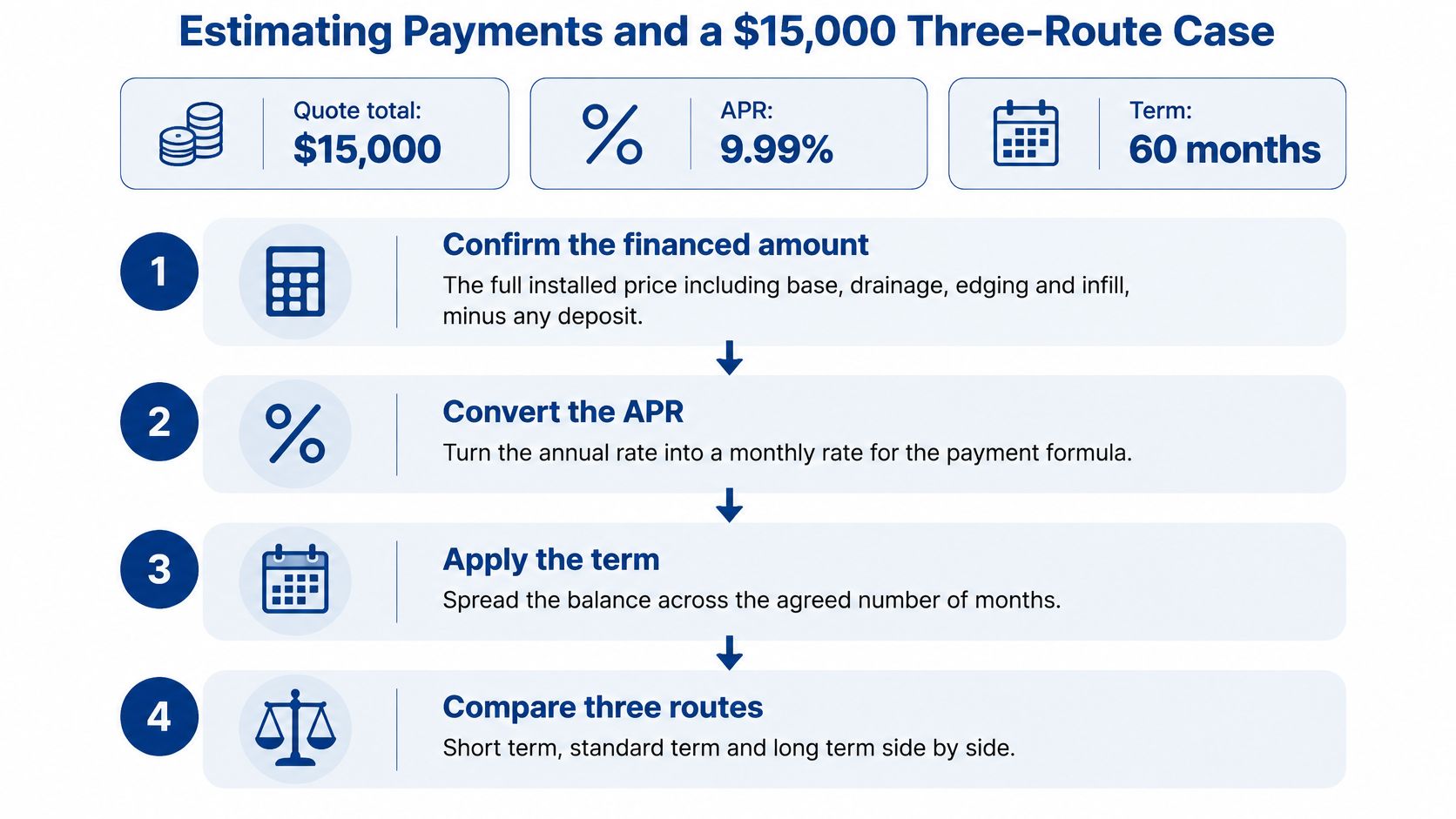
- Confirm the amount financed. Start with the full installed price and subtract any deposit. Check that the financed figure includes the work needed to complete the project. If base reconstruction, drainage, edging, or infill is excluded, the resulting payment does not represent the full job.
- Convert the APR to a monthly rate. Divide the annual rate by 12. A 10% APR becomes roughly 0.833% per month, or 0.00833 in decimal form.
- Set the term in months. Compare offers using the same repayment period. A longer term can lower the payment while increasing the time interest accrues.
- Calculate the payment. Use a loan calculator or the standard formula: principal multiplied by the monthly rate, divided by one minus (one plus the monthly rate) raised to the negative number of months. At a monthly rate of 0.00833 over 60 months, the divisor is about 0.392. For $15,000, that gives a payment near $319.
- Find the total interest. Multiply the payment by the number of months, then subtract the principal. This shows what borrowing adds to the project cost.
| Principal | APR | Term | Monthly payment | Total interest |
|---|---|---|---|---|
| $15,000 | 10% | 60 months | about $319 | about $4,120 |
| $15,000 | 20% | 60 months | about $397 | about $8,850 |
| $15,000 | 10% | 120 months | about $198 | about $8,780 |
| $20,000 | 10% | 60 months | about $425 | about $5,500 |
| $20,000 | 20% | 60 months | about $530 | about $11,800 |
Four routes on one backyard
Consider the same $15,000 installed system under four payment routes. The monthly figure is only one part of the comparison. The total paid, any conditions attached to the offer, and how long the turf is expected to serve your household all matter.
Route A, cash from savings. There is no interest or application, and no loan lien. The project uses $15,000 of your reserves at once. That is the full project cost, but the money is no longer available for other household needs.
Route B, a 12-month promotional plan. Paying about $1,250 each month clears the $15,000 balance in a year, with no interest if the balance is paid by the deadline. Miss that deadline, and deferred interest may be applied to the original amount. Read the terms closely: a low initial payment does not guarantee a low total cost.
Route C, a 5-year personal loan at 10% APR. The payment is about $319 a month, with $4,120 in interest and a total cost near $19,120.
Route D, the same loan over 10 years. The payment falls to about $198 a month, but interest rises to $8,780. That is roughly twice the five-year interest bill. The smaller payment comes with a higher total borrowing cost.
Cash costs least in total, while the promotional plan costs nothing in interest only if you meet its payoff condition. Between the two loans, the longer term lowers each payment but costs more overall. Include the replacement cycle in the decision: a loan term should be considered alongside how long the installation is expected to serve, rather than treated as a monthly-payment choice alone.
What moves the rate, and what to check before signing
Unsecured personal-loan APRs for home improvement can range from about 6% to 36%, with repayment periods commonly spanning two to twelve years, depending on creditworthiness, amount, and term, according to US News lending coverage. The examples show how much the rate can change the bill: borrowing $20,000 for 60 months at 10% APR costs about $425 a month and roughly $5,500 in interest. At 20% APR, the same principal and term cost about $530 a month and roughly $11,800 in interest.
Compare offers against the same project scope and ask for the cash price, any contractor or promotional financing terms, and a secured home-equity option if relevant to your situation. Check the APR, origination fees, prepayment penalties, whether the loan places a lien on the property, the minimum monthly payment, and the deadline for paying off a zero-interest promotion. Those details can change the total more than the monthly figure suggests.
Treat resale value as uncertain, not as a repayment plan. Landscaping may contribute to resale value, but the amount recovered depends on the design and conditions, so do not rely on it to cover borrowing costs. Specialty work may also have a different price from a standard lawn. For example, what a pet turf system costs depends on the features included, so use the quoted installed total when comparing financing routes.
Who Pays Cash and Who Finances Turf
Payment method tracks project size more closely than almost any other variable. Harvard's Joint Center for Housing Studies found that in 2023, 76% of home-improvement projects were paid for primarily with cash, while contractor-arranged financing accounted for 2% of projects, credit cards for 6% and home-equity-based financing for 5%, according to the Improving America's Housing report.
| Payment method | Share of projects | Average project spend |
|---|---|---|
| Savings or cash | 76% (primarily cash) | about $5,000 (from savings) |
| Credit cards | 6% | about $4,000 |
| Contractor-arranged financing | 2% | about $10,600 |
| Home equity | 5% | about $13,000 |
The average spends explain the pattern. Credit-card projects came in around $4,000, savings-funded projects around $5,000, contractor-financed projects around $10,600, and home-equity-funded projects around $13,000. Cheaper projects get paid for out of pocket. Expensive ones get spread out.
Why scope, not income, decides the route
A small artificial grass job, say a side-yard strip or a single pet run over an existing prepared base, behaves like a $4,000 to $5,000 project. Cash fits it. A full backyard conversion with excavation, a compacted aggregate base, drainage correction, edging, seams, specialty infill and hauling away the old lawn behaves like a five-figure project, and that's the range where the financing share climbs. Putting greens and commercial or sports surfaces push higher again.
Practical rule: price the scope first, then choose the payment route it resembles. Financing a $4,000 job costs more in interest than the convenience is worth, and paying a $16,000 job entirely from savings can leave you with no cushion.
For artificial grass specifically, financing is most useful when it buys a complete system rather than turf material on top of a base you still have to fund. The all-in number is the one that determines whether the surface performs.
One caution follows from the same data: financing is a minority route nationally, so a provider that assumes every customer wants credit is reading the market wrong. Clear pricing, itemized quotes and several payment options matter more than a pitch about monthly affordability.
Why Approval Is Harder for Some Households
Demand for renovation money is broad, but access to it isn't. The Urban Institute reports that about 30% of homeowners begin at least one renovation annually, spending an average of approximately $9,500, and that 77% paid for renovations with cash savings, 6.4% used credit-card debt, and only about 5.4% relied on cash-out refinancing or home-equity loans and lines of credit, according to its analysis of homeowner renovation financing.
The approval gap is sharper than the demand gap. In 2024, more than 33% of home-improvement-loan applicants had household incomes below $50,000, yet only 27% of applications from that group were approved. Income isn't the only filter, but it's the one that determines whether a full yard conversion is a monthly payment or a cash-only project.
If your budget is tight, work through this sequence rather than applying for the largest number available:
- Ask for a smaller first phase. A pet area or one high-use section can be installed now and extended later, which lowers the borrowed amount and keeps the payment inside your comfort range.
- Request quotes at more than one price level. A different turf specification, a smaller footprint or a simpler edge detail can change the total without changing how the yard functions day to day.
- Ask whether pre-qualification uses a soft credit inquiry. A soft check that doesn't affect your score is a sensible first step before a hard application.
- Build a reserve before committing. Even an approved loan leaves you paying for maintenance and eventual replacement out of income rather than credit.
Phasing is the practical answer for most households that don't qualify for a large renovation loan. It reduces the amount financed, keeps each payment modest, and gets the yard usable sooner. Whatever route you take, approval terms, interest, payment obligations and the total cost should be explained before any work is scheduled.
Installed Price Versus Full Ownership Cost
A financed quote tells you what the installation costs. It doesn't tell you what owning the surface costs, and the two numbers diverge once the loan ends and the turf keeps aging.
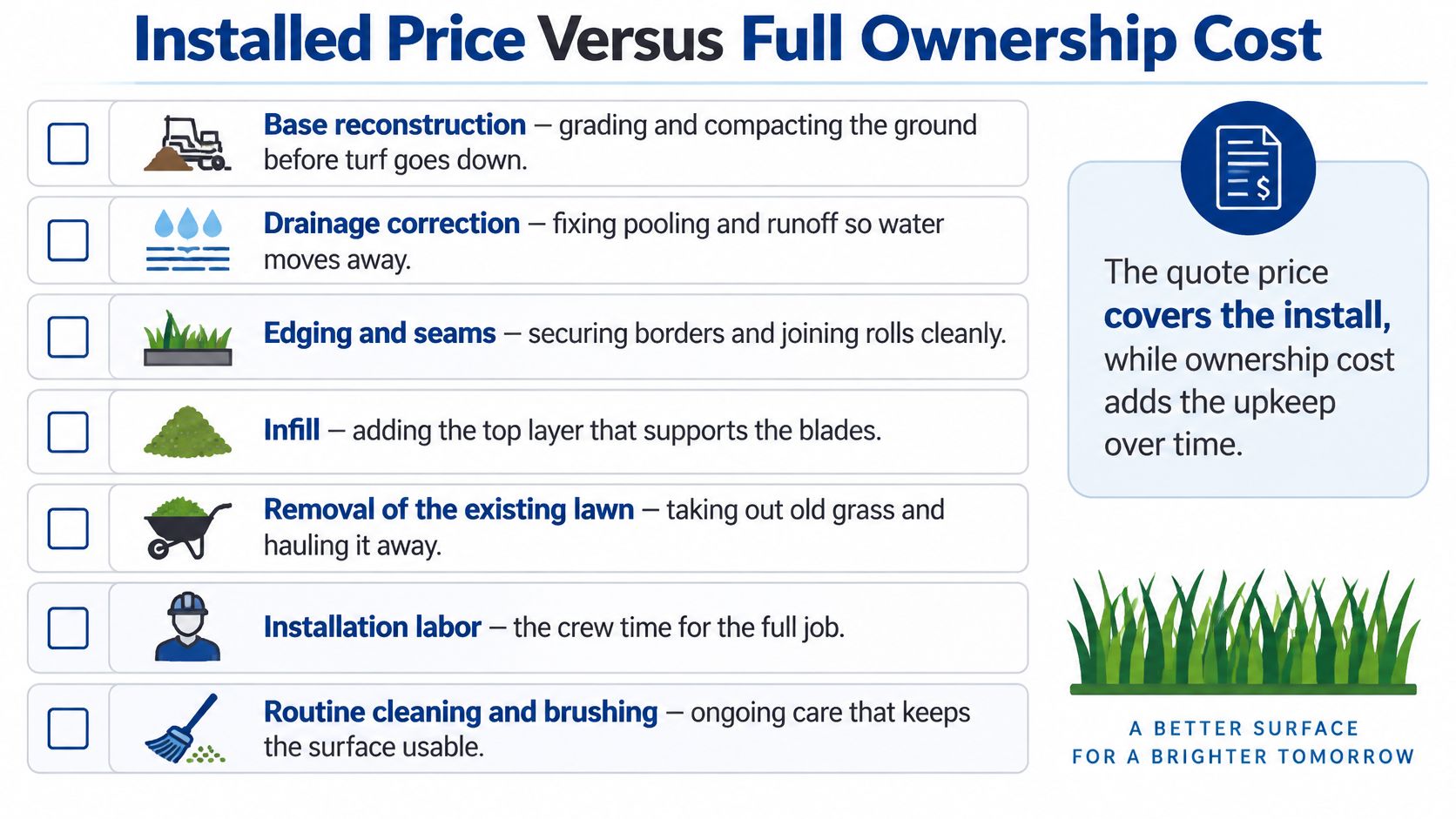
Start by confirming what the quote includes. Every excluded line changes your effective cost:
- Base reconstruction, including grading and compaction, not turf laid onto existing soil.
- Drainage correction, so water moves away from the house and doesn't pool in low spots.
- Edging and seams, the details that keep borders tight and joins invisible.
- Infill, the layer that supports the blades and, for pet areas, controls odor.
- Removal of the existing lawn, including hauling it off site.
- Installation labor for the full job rather than a partial crew day.
- Routine cleaning and brushing, which is small but annual.
- Repairs and replacement, the line most quotes never mention.
Then calculate an annualized ownership cost: add site preparation, turf, infill, drainage, labor, cleaning, repairs and a replacement reserve, and divide the total by the expected service years. A municipal field assessment of a 9,000-square-meter system estimated useful life at approximately 10 years, noted periodic replacement or reinstallation needs after roughly 8 to 10 years, and reported materially higher upfront costs than natural grass, according to Verona's artificial turf field study.
Compare that annual figure against financed principal plus interest, then against the costs you stop paying: mowing, irrigation, fertilizer and seasonal restoration. When those avoided costs roughly match the annualized ownership figure, the comparison is close. When they don't, the turf is a lifestyle purchase rather than a money-saving one, and that's worth knowing before you sign.
A five-year loan can be fully repaid on a surface that's already halfway to replacement. Budget for the second capital event from month one, not the year the blades start matting.
The reserve calculation, in practice
For a homeowner, the reserve is the expected replacement cost divided by the service life, set aside annually. For a school or commercial operator the same formula applies but with more urgency, since a closed field or a roped-off play area has an operational cost on top of the capital one. Keeping that reserve separate from the loan payment prevents a low monthly figure from hiding a large future liability.
The routine care that keeps the surface inside its expected life is modest: rinsing, debris removal and brushing the high-traffic zones. The steps in this guide to how to maintain artificial turf cover the seasonal work that protects the investment between installs.
Fill in the checklist above for every quote you receive, in writing. Two offers only compare once both show the same inclusions.
Reading Contracts, Warranties and Fine Print
A low monthly payment can still hide a second bill. Read the contract the way you read a utility statement: one line at a time, and turn each line into either dollars or a date you can miss.
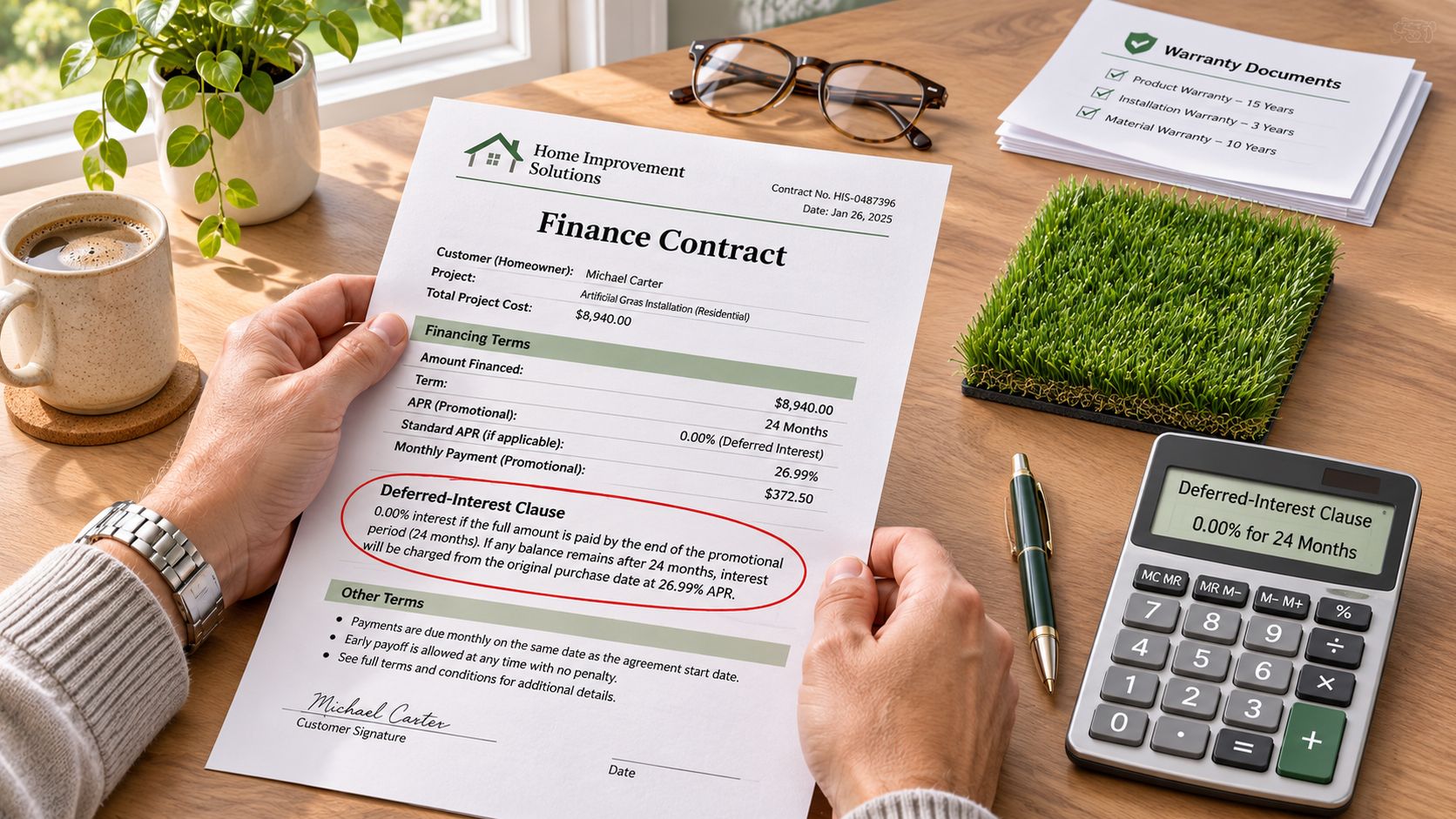
Deferred interest. A promotional plan with no interest for 12 or 18 months usually adds a retroactive charge if the balance is not cleared by the deadline. That clause is the one most likely to add four figures, and it is often printed smaller than the payment. It works like a parking ticket that, if unpaid by the date on the stub, bills every day the car sat there, not only the last day.
Origination fees. A fee of a few hundred dollars lifts the effective rate above the advertised APR. Ask for the total of payments with fees included, not the interest rate alone.
Prepayment penalties. If you expect to pay the loan off early with a bonus or a tax refund, confirm that extra payments cut principal and carry no charge.
Lien security. A home-secured loan or HELOC puts the house behind the balance. Unsecured borrowing skips the collateral and usually costs more. Know which document you are signing.
Minimum monthly payment and payoff deadline. Minimums on revolving credit can keep a balance alive for years. On a promotional plan, the deadline is a hard date.
The warranty needs the same line-by-line reading. Field-design guidance cites an approximate 8 to 12 year life for heavily used systems and recommends planning for maintenance, resurfacing, disposal and construction disruption, according to LAN Associates' synthetic turf field design guidance. A warranty may cover manufacturing defects and still exclude poor drainage, neglect, pet damage or normal wear. Warranty length is a materials promise. Service life is how long the surface lasts under your use. Those two numbers rarely match, so a short loan can be paid off while the turf is only partway through its replacement cycle. Compare routes by what you will have paid in total by the time you replace the surface, not by which monthly figure looks smallest.
End of life belongs in the budget
Synthetic turf has limited recyclability and several end-of-life options: reuse, landfill, incineration or recycling. Removal, hauling and disposal are real costs. They arrive years after the loan closes, so they belong in the reserve. A route that looks cheaper each month can cost more across a full replacement cycle once disposal and any deferred-interest catch-up are added back in.
Questions to put in writing before you sign
- Does the quote include base reconstruction, compaction and drainage correction?
- What is the promotional payoff deadline, and what interest applies if it is missed?
- Is prepayment allowed without a fee, and do extra payments reduce principal?
- Request the full warranty text so you can read what voids it and who is responsible when drainage fails after installation.
- What does removal and disposal of the surface cost at end of life?
Get the answers in writing. A verbal assurance about drainage is not a remedy.
Confirm the Financing Terms Before You Sign
The decision comes down to a single comparison. Ask for three versions of the same scope: the cash price, the financed price with the APR and term stated, and any promotional deferred-interest terms. Run the payment calculation from earlier on each financed version and compare total cost, not the monthly figure.
Before signing, confirm these points in writing:
- The installed total includes base, drainage, edging, seams and infill.
- The APR, term and monthly payment match your own calculation, not just the lender's.
- The payoff deadline, prepayment rules and fees are stated on the document.
- The warranty exclusions are understood, including drainage, pet damage and normal wear.
- A replacement reserve is set aside from the start, so the end-of-life cost doesn't arrive as a surprise.
If a provider advertises zero down or interest-free terms, confirm the conditions, the payoff date and whether retroactive interest applies to the original balance. In Indianapolis, installed artificial turf typically runs $8 to $15 per square foot, which puts most residential yards in the range where the term length matters as much as the rate; we offer monthly payment plans with zero money down and interest-free options, so a cash quote and a financed quote can be compared side by side from the same contractor. If you're still deciding how much base work the project needs, this explanation of the artificial grass base layer shows why that line item shouldn't be trimmed to hit a payment target.
Get itemized quotes from two providers, run the same five steps on each financed version, and choose the lowest total cost that still leaves your savings intact.
Waterloo Turf Indianapolis installs complete synthetic grass systems across the metro, from base construction and drainage to infill and final brushing, and we offer monthly payment plans with zero money down and interest-free options so you can compare a financed quote against a cash one. If you'd like a written scope that itemizes base, drainage, edging and infill before you decide how to pay for it, request an estimate from Waterloo Turf Indianapolis and we'll walk through the numbers with you.